
Every commercial aircraft at the gate draws enough power to run 60 homes. But here is the catch: it needs that power at 400Hz, not the 50Hz or 60Hz that comes out of a standard wall socket. An aircraft ground power frequency converter is the specialized static converter that transforms standard grid power into the precise 400Hz, 115V/200V electricity that aircraft electrical systems require while parked.
Airport operators, MRO facilities, and ground handling companies face a constant challenge. Diesel ground power units have been the default choice for decades, yet they are noisy, polluting, and expensive to maintain. Static frequency converters offer a cleaner, quieter, and more cost-efficient alternative, but the technical details of 400Hz power, aircraft interlock systems, and GPU architecture are rarely explained in a way that procurement teams can act on.
In this guide, you will learn why aircraft use 400Hz power, how a static aircraft ground power frequency converter works, what types of GPU systems exist, and how to select the right setup for your airport or hangar.
الوجبات السريعة الرئيسية
- Aircraft use 400Hz power because higher frequency reduces transformer and motor weight by 60-70%, critical for aviation where every kilogram matters.
- A static aircraft ground power frequency converter uses AC-DC-AC architecture with specialized output filtering to deliver stable 115V/200V at 400Hz with less than 0.01% frequency deviation.
- Three GPU architectures dominate: fixed centralized systems for large hubs, point-of-use converters for gate-level distribution, and mobile units for remote stands and MRO hangars.
- ISO 6858, MIL-STD-704F, and GJB 572A define the voltage, frequency, and connector standards your GPU must meet for commercial or military aircraft.
- A Boeing 737 requires approximately 90 kVA of ground power; an Airbus A380 needs up to 270 kVA, making correct sizing essential.
Why Aircraft Use 400Hz Power

The Physics Behind Aircraft Electrical Systems
Aircraft electrical systems operate at 400Hz for one simple reason: weight. In an aircraft, every kilogram of equipment translates directly into fuel burn, range reduction, and operating cost. At 400Hz, transformers and electric motors can be designed with significantly less iron and copper than their 50Hz or 60Hz equivalents.
The relationship is straightforward. The core cross-sectional area of a transformer is inversely proportional to frequency. At 400Hz, the required core area is roughly one-eighth of what is needed at 50Hz. The result is a transformer that weighs 60-70% less while delivering the same power. For an aircraft carrying dozens of transformers and motors across its electrical and environmental systems, the cumulative weight savings are substantial.
Electric generators also benefit. A 400Hz generator spins at 24,000 RPM for a two-pole design or 12,000 RPM for a four-pole design, compared to 3,000 or 1,500 RPM at 50Hz. The higher rotational speed allows a smaller frame size for the same kVA output. Smaller generators mean less weight, less space, and lower mechanical inertia.
400Hz vs 50/60Hz: Quick Comparison
| معامل | 50/60Hz Industrial | 400Hz Aircraft |
|---|---|---|
| وزن المحول | خط الأساس (100%) | 30-40% من خط الأساس |
| وزن المحرك | خط الأساس (100%) | 25-35% من خط الأساس |
| سرعة المولد | 1,500-3,000 RPM | 12,000-24,000 RPM |
| Cable size for same current | خط الأساس | Smaller (less copper needed) |
| التطبيقات النموذجية | Grid power, industry | Aircraft, military, some marine |
The trade-off is increased eddy current and hysteresis losses at higher frequencies, which is why 400Hz is the practical ceiling. Below 400Hz, weight savings diminish. Above it, cooling requirements and losses escalate. The aviation industry settled on 400Hz as the optimal balance decades ago, and it remains the global standard today.
Why Not Just Use Standard Grid Power?
An aircraft plugged into 50Hz or 60Hz ground power would face immediate problems. Its onboard transformers would saturate, its motors would overheat, and its sensitive avionics would receive the wrong clock frequency. Ground power must match the aircraft’s onboard electrical design exactly. That is why a dedicated aircraft ground power frequency converter is not optional at any commercial airport or military airfield.
What Is an Aircraft Ground Power Frequency Converter?
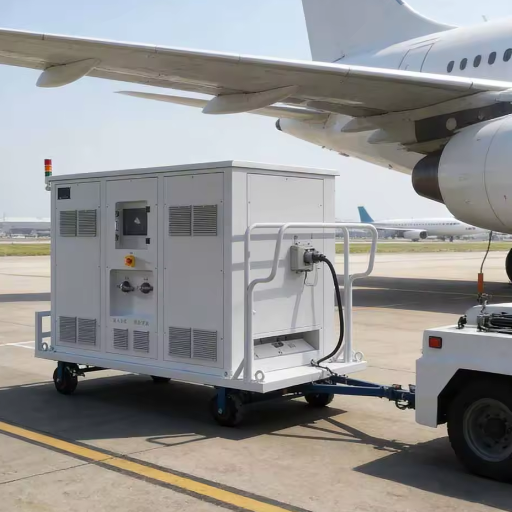
An aircraft ground power frequency converter is a specialized static converter that takes standard AC input (typically 380V or 480V at 50Hz or 60Hz) and converts it into precisely regulated 115V/200V three-phase power at 400Hz. It is purpose-built for the unique demands of aircraft ground support equipment (GSE).
At its core, the device follows the same AC-DC-AC architecture found in any محول التردد ذو الحالة الصلبة: a rectifier stage converts incoming AC to DC, a DC link stabilizes the intermediate voltage, and an inverter stage generates the 400Hz output through high-speed IGBT switching. However, an aviation-grade unit adds several specialized layers. The output filter must suppress high-frequency switching noise without introducing phase shift at 400Hz. The voltage regulation loop must hold 115V line-to-neutral and 200V line-to-line within tight tolerances, typically plus or minus 3 volts under ISO 6858. The frequency control must maintain 400Hz with less than 0.01% deviation under steady-state conditions.
Unlike general-purpose static converters, aircraft units also incorporate aircraft-specific connectors, interlock circuits, and protection systems that interface directly with the aircraft’s electrical bus. The result is a ground power source that the aircraft treats as if it were its own onboard generator.
How a 400Hz Static Frequency Converter Works
Input Rectification and Power Factor Correction
The first stage of an aircraft ground power frequency converter is the input rectifier. For units below 75 kVA, a simple six-pulse diode bridge is common. For larger units or installations where harmonic distortion must be strictly controlled, an active front end (AFE) rectifier uses IGBTs to draw sinusoidal current from the grid and achieve a power factor near unity. The choice between diode and AFE rectification affects input current THD, regenerative capability, and cost. For most airport applications where the converter runs continuously during turnaround periods, a diode rectifier with input line reactors offers the best balance of reliability and price.
High-Frequency DC Link
After rectification, the DC bus capacitor bank smooths the pulsating DC into a stable intermediate voltage. For a 400Hz output, the DC link is typically maintained at 540-600VDC for a 380VAC input or 650-700VDC for a 480VAC input. The capacitor selection is critical. Film capacitors are preferred over electrolytic types in aviation-grade converters because they tolerate higher ripple current, have longer lifespans, and fail gracefully rather than explosively. At Shandong Electric, we specify metallized polypropylene film capacitors with a 100,000-hour design life for our aviation product lines.
400Hz Inversion and Output Filtering
The inverter stage is where the magic happens. Using pulse-width modulation (PWM) at a carrier frequency of 8-16 kHz, the IGBT bridge reconstructs a sinusoidal waveform at 400Hz. The choice of carrier frequency involves a trade-off: higher frequencies produce cleaner output with lower THD but increase switching losses and electromagnetic interference. Most aviation converters settle on 10-12 kHz as the practical optimum.
After the inverter, a dedicated output filter removes the high-frequency switching components while preserving the 400Hz fundamental. Aviation filters are more demanding than industrial filters because aircraft electrical systems are sensitive to both voltage waveform distortion and common-mode noise. A typical filter combines differential-mode inductors, capacitors, and sometimes an isolation transformer to provide galvanic separation between the grid and the aircraft.
Aircraft-Specific Output Stage
The final stage includes the output contactor, voltage and current monitoring, and the aircraft connector interface. The contactor is controlled by the interlock circuit, ensuring that power is only applied when a valid aircraft connection is detected. Voltage feedback from the output terminals drives the regulator loop, adjusting the PWM modulation index to compensate for cable voltage drop and load changes. In a well-designed converter, the output voltage at the aircraft receptacle stays within plus or minus 2% even as load current swings from 0% to 100%.
أنواع أنظمة الطاقة الأرضية
Fixed Centralized Systems
In a fixed centralized architecture, one or more large static converters are installed in a central electrical room. From there, 400Hz power is distributed via dedicated cables to multiple gates or stands. A 500 kVA central unit, for example, can serve four to six narrow-body gates simultaneously through a distribution switchboard.
The advantages are clear. Centralized systems benefit from economies of scale: one large converter is typically cheaper per kVA than multiple smaller units. Maintenance is concentrated in one location. Cooling and environmental control are easier to manage in a dedicated room. The disadvantages are equally real. Cable runs from the central room to remote gates can exceed 100 meters, introducing voltage drop that must be compensated. A failure in the central unit affects multiple gates unless redundancy is built in. And upgrading capacity requires replacing or augmenting the central equipment, which is disruptive.
Centralized systems suit large international hubs with dedicated electrical buildings and predictable gate assignments. They are less ideal for smaller airports or facilities where gate configurations change frequently.
Point-of-Use Converters
A point-of-use system places an individual static converter at each gate, typically in a weatherproof cabinet mounted on the jet bridge pier or in a nearby equipment room. Each converter serves one gate independently. A common configuration is 90 kVA for narrow-body gates and 180 kVA for wide-body gates.
Point-of-use systems eliminate long cable runs and the associated voltage drop. Each gate operates independently, so a converter failure affects only one stand. Installation is modular: new gates can be added by simply adding another converter without touching the central system. The trade-off is higher capital cost per kVA and distributed maintenance requirements. Technicians must visit each gate for routine service rather than working in one central location.
For retrofit projects and medium-sized airports, point-of-use is often the more practical choice. The shorter installation timeline and lower disruption to existing operations make it attractive for facilities upgrading from diesel GPUs.
Mobile GPUs and eGPUs
Mobile ground power units fall into three categories. Traditional diesel-powered GPUs are self-contained generator sets mounted on a towable cart. They have been the workhorse of airport ground operations for decades. They require no fixed infrastructure, can be moved to any stand, and provide both 400Hz AC and 28VDC output. Their drawbacks are significant: noise levels of 85-95 dB, diesel exhaust emissions, high fuel costs, and intensive maintenance schedules.
Static mobile units replace the diesel engine with a static converter on a cart. They plug into the airport’s grid power and deliver 400Hz through a cable reel. They are silent during operation, emit no exhaust, and require only electrical maintenance. The limitation is that they need a grid connection at or near the stand, which may not exist at remote aprons.
Battery-powered eGPUs represent the newest category. These units store energy in lithium-ion battery packs and deliver 400Hz output through a static inverter. They are completely independent of grid connections, produce zero emissions, and operate silently. Current battery technology allows 2-4 aircraft turnarounds per charge for narrow-body operations. The upfront cost is higher than diesel, but operating costs are minimal. Major airports including Heathrow and Changi have begun mandating eGPU transitions as part of their net-zero ground operations strategies.
Output Specifications and Tolerances

Voltage and Frequency Ranges
Aircraft electrical systems are unforgiving. The power supplied by a ground unit must meet strict tolerances to avoid avionics errors, motor overheating, or protective relay trips.
| معامل | ISO 6858 (Commercial) | MIL-STD-704F (Military) | Typical Static Converter Spec |
|---|---|---|---|
| الجهد الاسمي | شنومكس / شنومكسف أس | شنومكس / شنومكسف أس | شنومكس / شنومكسف أس |
| تحمل الجهد | plus or minus 3V | plus or minus 2V | plus or minus 2V |
| التردد الاسمي | 400Hz | 400Hz | 400Hz |
| تحمل التردد | plus or minus 0.1% | plus or minus 0.01% | plus or minus 0.01% |
| توازن الطور | plus or minus 2V | plus or minus 1V | plus or minus 1.5V |
| THD | أقل من٪ 5 | أقل من٪ 3 | أقل من٪ 2 |
Static frequency converters comfortably exceed commercial requirements. A well-designed unit achieves less than 2% THD, plus or minus 0.01% frequency stability, and or minus 1.5V phase balance. This performance margin is important because real-world conditions include cable voltage drop, temperature variations, and load transients that all push the output away from nominal.
متطلبات جودة الطاقة
Beyond voltage and frequency, aircraft power systems are sensitive to voltage modulation, flicker, and DC offset. Voltage modulation refers to low-frequency amplitude variations superimposed on the 400Hz carrier. Even small modulation levels can cause flicker in aircraft lighting and instability in motor drives. Static converters with fast digital control loops suppress modulation to less than 0.5%, well below the thresholds that cause operational issues.
DC offset is another concern. Any DC component in the AC output can cause transformer saturation in the aircraft’s power distribution system. Quality static converters include DC offset compensation that holds the DC component to less than 50 millivolts.
Aircraft Interlock and Safety Systems
The 28VDC Interlock Circuit
Aircraft GPU connectors are not simple power plugs. They include an interlock circuit that prevents the application of power unless a valid aircraft connection is confirmed. The interlock uses Pins E and F in standard aircraft connectors. These pins carry a 28VDC signal between the aircraft and the GPU.
When the GPU cable is properly mated to the aircraft receptacle, Pins E and F complete a circuit that tells the GPU control system an aircraft is connected. Only then will the output contactor close and apply 400Hz power. If the cable is disconnected while power is flowing, the interlock opens first ( Pins E and F break before the power pins separate), causing the contactor to open and cut power before the power pins arc. This sequencing prevents live disconnection, which would damage both the connector and the aircraft receptacle.
Understanding the interlock is essential for anyone specifying or maintaining GPU systems. A faulty interlock circuit is a common cause of “no power” complaints that are misdiagnosed as converter failures.
أنواع الموصلات والمعايير
Commercial aircraft typically use MS (Military Standard) series connectors or CEEC (Centralized Electric Power Connector) types. The exact connector depends on the aircraft manufacturer and the ground power standard adopted by the airline or air force. Shandong Electric supplies GPUs with configurable connector interfaces, allowing the same converter chassis to serve different aircraft fleets by swapping the output cable assembly.
ميزات الحماية
Modern aircraft ground power frequency converters include comprehensive protection. Overcurrent protection limits output current to prevent cable or aircraft bus damage. Overvoltage and undervoltage protection disconnect the output if the voltage drifts outside safe limits. Ground fault detection monitors for insulation failures. Emergency stop circuits allow immediate shutdown from a remote button. These protections are not optional extras; they are required by airport safety regulations and aircraft manufacturer specifications.
الامتثال للمعايير
ISO 6858 (Commercial Aviation)
ISO 6858 specifies the characteristics of electrical power supplied to aircraft during ground operations. It defines voltage levels (115V line-to-neutral, 200V line-to-line), frequency (400Hz), tolerances, and connector requirements. Any GPU serving commercial aircraft must meet ISO 6858 as a baseline. Airlines and airport authorities typically reference this standard in their procurement specifications.
MIL-STD-704F (Military Aircraft)
MIL-STD-704F is the U.S. Department of Defense standard for aircraft electric power characteristics. It is stricter than ISO 6858 in several respects: tighter voltage tolerance (plus or minus 2V vs plus or minus 3V), tighter frequency tolerance (plus or minus 0.01% vs plus or minus 0.1%), and lower THD limits (less than 3% vs less than 5%). Military GPUs must also meet additional electromagnetic interference and environmental requirements. A static converter designed for military use is inherently suitable for commercial applications, but the reverse is not always true.
GJB 572A (Chinese Military Aviation)
GJB 572A is the Chinese military equivalent of MIL-STD-704F. It specifies power characteristics for military aircraft ground support equipment in China. For defense contractors and airports serving military aviation in China, GJB 572A compliance is mandatory. Shandong Electric designs GPU systems that meet GJB 572A, MIL-STD-704F, and ISO 6858 simultaneously, allowing a single platform to serve both civilian and military customers.
جدول المراجع المتقاطعة
| متطلبات | ISO 6858 | ميل-ستد-704ف | جي جي بي 572 أ |
|---|---|---|---|
| تطبيق | الطيران التجاري | جيش الولايات المتحدة | الجيش الصيني |
| Voltage (L-N) | 115V AC | 115V AC | 115V AC |
| تحمل الجهد | plus or minus 3V | plus or minus 2V | plus or minus 2V |
| تردد | 400Hz | 400Hz | 400Hz |
| تحمل التردد | plus or minus 0.1% | plus or minus 0.01% | plus or minus 0.01% |
| THD limit | أقل من٪ 5 | أقل من٪ 3 | أقل من٪ 3 |
| معيار الموصل | CEEC / MS | MS | MS / custom |
Selecting a 400Hz GPU for Your Airport or Hangar
Step 1: Determine Your Aircraft Mix
The starting point for any GPU selection is understanding what aircraft you will serve. Ground power requirements vary dramatically between a regional jet and a wide-body long-haul aircraft.
| نوع الطائرة | Typical GPU Requirement | ملاحظة |
|---|---|---|
| Regional jets (CRJ, ERJ) | 45-60 kVA | Often served by smaller point-of-use units |
| Narrow-body (B737, A320) | 90 كيلو فولت أمبير | Most common gate requirement worldwide |
| Wide-body (B777, A350) | 180 كيلو فولت أمبير | Requires larger converter or dual units |
| Super wide-body (A380) | 270 كيلو فولت أمبير | May need two 180 kVA units in parallel |
| Military fighters | 30-60 kVA | Often require dual AC + 28VDC output |
An airport serving a mix of narrow-body and wide-body aircraft needs a flexible system. One approach is to size every gate for the largest expected aircraft, which is capital-intensive but simple. A smarter approach is to designate some gates for narrow-body (90 kVA) and others for wide-body (180 kVA), then assign aircraft to gates accordingly.
Step 2: Choose System Architecture
Once you know your power requirements, the next decision is architecture. Ask these questions:
- Do you have a central electrical room with space for large converters and distribution boards?
- Are your gates within 50 meters of that room, or are cable runs much longer?
- Is your gate configuration fixed, or do you reallocate stands frequently?
- Do you need power at remote stands with no fixed infrastructure?
- What is your budget for initial installation versus long-term operating costs?
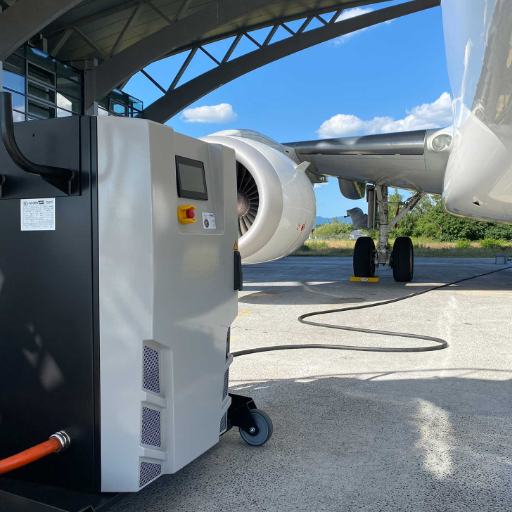
If you answered yes to central room, short cables, and fixed gates, a centralized system may be most economical. If your gates are spread out, your configuration changes, or you need flexibility, point-of-use converters make more sense. For remote stands and MRO hangars, mobile or eGPU units are often the only practical option.
Step 3: Specify Output Requirements
Decide whether you need AC-only output or dual AC/DC output. Commercial airliners need only 400Hz AC. Military aircraft and some business jets also require 28VDC for engine starting and avionics. A dual-output GPU contains both a 400Hz static converter and a 28VDC rectifier/battery system in one enclosure. This eliminates the need for separate DC carts but adds cost and complexity.
Also consider whether you need single-aircraft or multi-aircraft capability. A 90 kVA point-of-use unit serves one narrow-body gate. A 500 kVA centralized unit with distribution can serve multiple gates simultaneously, provided the total load does not exceed capacity.
الخطوة 4: تقييم العوامل البيئية وعوامل التثبيت
Indoor hangar installations face different constraints than outdoor apron installations. Outdoor units need appropriate IP ratings (IP54 minimum for weather protection), corrosion-resistant enclosures, and temperature compensation for extreme climates. In tropical environments like Southeast Asia, ambient temperatures of 40 degrees Celsius are common, requiring derating or enhanced cooling. In cold climates, startup behavior and capacitor performance at low temperatures must be verified.
Foundation requirements also differ. A centralized converter room needs civil construction. Point-of-use cabinets need concrete pads or pier mounts. Mobile units need only a level surface and a grid power outlet.
Worked Example: Regional Airport Gate Upgrade
Consider a regional airport in Southeast Asia upgrading from diesel GPUs to static converters at four narrow-body gates. The airport serves A320 and B737 aircraft exclusively, each requiring 90 kVA.
After evaluating centralized versus point-of-use options, the airport selects point-of-use static converters. The gates are spread across two concourses 200 meters apart, making centralized distribution uneconomical due to cable costs. Each gate receives a 90 kVA static converter in an IP54 outdoor cabinet. The converters draw 380V 50Hz input from the airport’s existing distribution and deliver 115/200V 400Hz through a 15-meter aircraft cable.
The result: noise levels at the gate drop from 90 dB (diesel) to under 65 dB (static). Fuel costs are eliminated. Annual maintenance drops from weekly oil checks and filter changes to annual fan filter replacement and thermal inspection. The payback period against diesel operating costs is approximately 4 years, after which the airport saves an estimated 12,000 dollars per gate annually.
الأسئلة الشائعة
Why do aircraft use 400Hz instead of 50/60Hz?
Aircraft use 400Hz because higher frequency allows transformers and motors to be significantly smaller and lighter. At 400Hz, a transformer weighs 60-70% less than an equivalent 50Hz unit. Since weight directly affects fuel consumption and payload capacity, the aviation industry adopted 400Hz decades ago as the optimal balance between weight savings and acceptable electrical losses.
Can a standard frequency converter power an aircraft?
No. A standard industrial frequency converter is not suitable for aircraft ground power. Aviation-grade units must meet strict output tolerances (plus or minus 2V, plus or minus 0.01% frequency), include aircraft-specific connectors and interlock circuits, and comply with ISO 6858 or MIL-STD-704F. Using a non-aviation converter risks aircraft electrical system damage and voids warranty coverage.
What is the difference between a GPU and an APU?
A GPU (Ground Power Unit) supplies external electrical power to an aircraft while it is parked at the gate. An APU (Auxiliary Power Unit) is a small turbine engine installed inside the aircraft that generates power and compressed air when the main engines are shut down. The GPU allows the APU to remain off, saving fuel and reducing noise and emissions at the gate.
How much power does a commercial airliner need on the ground?
A narrow-body aircraft like the Boeing 737 or Airbus A320 typically requires 90 kVA of ground power. A wide-body such as the Boeing 777 or Airbus A350 needs approximately 180 kVA. The largest commercial aircraft, the Airbus A380, can draw up to 270 kVA. Regional jets require less, typically 45-60 kVA.
What is an eGPU and how does it differ from a diesel GPU?
An eGPU (electric Ground Power Unit) is a battery-powered or grid-connected static converter that delivers 400Hz power without an internal combustion engine. Unlike diesel GPUs, eGPUs produce zero emissions, operate silently, and require minimal maintenance. Battery-powered eGPUs are ideal for airports pursuing net-zero ground operations. The main limitation is battery capacity, which currently supports 2-4 narrow-body turnarounds per charge.
Do I need a dual AC/DC GPU or AC-only?
Commercial airliners require only 400Hz AC ground power. Military aircraft, some business jets, and certain maintenance procedures also need 28VDC. If your operation serves only commercial airlines, AC-only is sufficient and more cost-effective. If you serve mixed fleets or military customers, a dual AC/DC GPU eliminates the need for separate DC power carts.
What standards should my GPU comply with?
For commercial aviation, ISO 6858 is the baseline standard. For military applications in the United States, MIL-STD-704F applies. For Chinese military aviation, GJB 572A is required. Many procurement specifications reference all three, and a converter designed to the strictest standard (MIL-STD-704F or GJB 572A) will automatically satisfy commercial requirements.
How long does a static GPU last compared to a diesel unit?
A well-maintained static frequency converter typically lasts 15-20 years. The main wear items are cooling fans (5-7 year lifespan) and DC bus capacitors (10-15 years). Diesel GPUs average 8-12 years, with engines requiring major overhauls at mid-life. The static converter’s longer lifespan and lower maintenance requirements contribute significantly to its lower total cost of ownership.
Can one GPU serve multiple gates?
A centralized static converter can serve multiple gates through a distribution switchboard, provided the total load does not exceed the converter’s rated capacity. For example, a 500 kVA centralized unit can power four to six narrow-body gates if the aircraft do not all draw maximum power simultaneously. Point-of-use converters serve only one gate each. The choice between centralized multi-gate and single-gate point-of-use depends on your airport layout, load diversity, and redundancy requirements.
What maintenance does a static aircraft GPU require?
Static aircraft GPUs require far less maintenance than diesel units. Annual maintenance typically includes cleaning or replacing air intake filters, inspecting cooling fans, checking DC bus capacitor health, verifying output voltage and frequency calibration, and testing interlock and protection circuits. Unlike diesel engines, there are no oil changes, fuel filters, exhaust systems, or starter motors to maintain. Predictive maintenance using digital monitoring can further extend service intervals by tracking thermal trends and component degradation.
خاتمة
Aircraft ground power is not just about delivering electricity to a parked plane. It is about matching the precise 400Hz, 115V/200V requirements that aircraft electrical systems demand, while meeting strict safety, noise, and environmental standards. A static aircraft ground power frequency converter delivers this power with the accuracy, reliability, and efficiency that modern airports require.
The technology choices are clearer than ever. Static converters outperform diesel GPUs in efficiency, noise, emissions, and total cost of ownership. Point-of-use systems offer flexibility for retrofit projects. Battery-powered eGPUs are emerging as the zero-emission solution for forward-looking airports. And unified compliance with ISO 6858, MIL-STD-704F, and GJB 572A ensures that the same platform serves civilian and military customers alike.
If you are planning an airport upgrade, a new hangar installation, or a transition from diesel to static ground power, the key is to start with your aircraft mix, choose the right architecture, and specify a converter built for aviation-grade performance from the ground up. Shandong Electric designs and manufactures aircraft ground power frequency converters for airports, military bases, and MRO facilities worldwide, with custom engineering support from specification through commissioning.
Contact our engineering team to discuss your ground power requirements and receive a tailored GPU specification for your operation.
