
A high voltage frequency converter in power generation is an electronic drive system that controls motor speed and generator starting by varying the frequency and voltage of electrical power. These systems are essential for power plant auxiliaries, pumped storage hydro, synchronous condenser starting, and emerging grid-forming applications.
In 2022, a 600 MW coal-fired plant in the US Midwest faced a problem familiar to every plant engineer. Auxiliary power was consuming 8% of gross generation. Mechanical throttling on boiler feed pumps was wasting enough energy to power 3,000 homes. The plant installed medium voltage VFDs on every major auxiliary. Within 18 months, auxiliary power dropped 22%. Fuel savings exceeded $1.2 million per year. The project paid for itself in 16 months. The secret was not just adding variable frequency drives. It was selecting the right converter topology for power plant duty.
You already know that a high voltage frequency converter power generation installation can improve efficiency and reduce operating costs. The challenge is matching the right drive type, topology, and specification to your specific application. Power generation demands differ fundamentally from general industrial use. Starting a 200 MW synchronous condenser requires a different approach than controlling a boiler feed pump. This guide focuses on those differences.
For a full technical foundation on drive types, voltage classes, and operating principles, see our complete guide to high voltage frequency converters. Before selecting a drive for your application, confirm you understand medium voltage VFD fundamentals so you can interpret specifications correctly.
Key Takeaways
- Power plant auxiliaries account for approximately 40% of power generation VFD demand; pumped storage is the fastest-growing segment
- VFD and motor systems achieve approximately 95% efficiency versus approximately 36% for mechanical throttling on boiler feed pumps
- SFC is preferred for gas turbine and synchronous condenser starting; pony motors still make sense for some retrofits
- Variable-speed pumped storage uses either full-size CFSM converters or AC excitation (doubly-fed) depending on speed range needs
- Grid-forming converters are becoming essential for low-inertia grids with high renewable penetration
- Typical energy savings: boiler feed pumps 15-25%, ID/FD fans 20-35%, cooling water pumps 15-30%
What Is a High Voltage Frequency Converter in Power Generation?
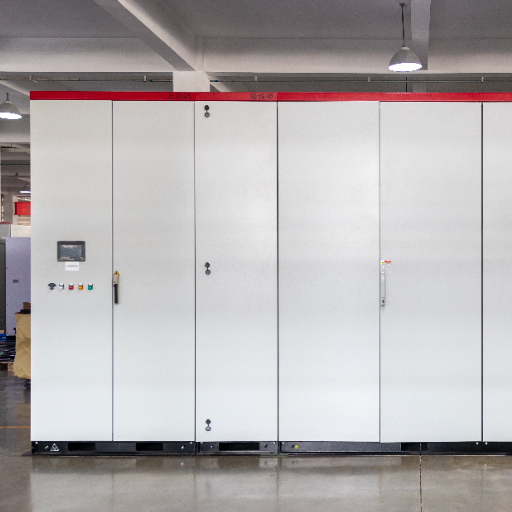
Defining Voltage and Power Classes for Utility Applications
High voltage frequency converters for power generation typically span 2.3 kV to 13.8 kV. Common utility voltage classes include 3.3 kV, 4.16 kV, 6.6 kV, and 6.9 kV. Larger installations may reach 11 kV or 13.8 kV for direct generator interface or large auxiliary motors.
Power ratings vary dramatically by application. A boiler feed pump VFD might range from 1 MW to 12 MW. A static frequency converter for gas turbine starting can reach 30 MW or more. Variable-speed pumped storage installations like the Grimsel 2 project use 100 MVA converters, among the largest ever deployed.
These converters must meet standards that general industrial drives do not. IEEE 519 governs harmonic distortion limits at the point of common coupling. NEMA MG1 Part 31 defines inverter-duty motor requirements for VFD-fed machines. IEC 61850 provides substation communication protocols that many utility-specified drives must support.
Why Power Generation Operations Need Variable Speed and Frequency Control
Power generation presents three unique challenges that demand specialized converter solutions.
First, large auxiliary motors often represent the single biggest electrical loads in a plant. A boiler feed pump on a 600 MW unit can draw 8-12 MW. Running this pump at fixed speed with mechanical throttling wastes enormous energy. Variable speed control matches pump output to boiler demand precisely.
Second, starting large synchronous machines requires controlled acceleration. Gas turbines, synchronous condensers, and pumped storage motor-generators cannot simply be line-started. The starting current would damage the machine and destabilize the plant grid. Frequency converters provide soft starting with controlled torque and speed ramps.
Third, grid stability requirements are evolving rapidly. As renewable penetration rises, system inertia declines. Grid-forming converters and synchronous condensers are increasingly necessary to maintain voltage and frequency stability. This creates new converter applications that did not exist a decade ago.
Want to see how drive selection changes across industries? While this guide focuses on power generation, many of the same topology principles apply to oil and gas VFD applications.
Power Plant Auxiliary Applications: Pumps, Fans, and Compressors
Boiler Feed Pumps and Condensate Extraction
Boiler feed pumps are the largest and most energy-intensive auxiliaries in thermal power plants. A typical 600 MW unit operates two or three feed pumps, each rated 5-12 MW. At fixed speed, these pumps run at full flow and use control valves to throttle excess output. This approach is mechanically simple but thermodynamically wasteful.
VFD control eliminates throttling losses by varying pump speed to match boiler demand. The savings are substantial. Boiler feed pump VFD retrofits typically reduce auxiliary power consumption by 15-25%. On a 10 MW pump running 8,000 hours per year, that translates to 1,200-2,000 MWh saved annually. At 60perMWh,annualsavingsreach60perMWh,annualsavingsreach72,000-$120,000 per pump.
Condensate extraction pumps benefit similarly. These smaller units (500 kW to 3 MW) run continuously at part load. VFD control optimizes flow to condenser hotwell level, improving heat rate and reducing pump wear.
Induced Draft and Forced Draft Fans
ID and FD fans control combustion airflow in boilers. Fixed-speed fans with inlet vane or damper control operate at roughly 60-70% efficiency at part load. VFD control improves this dramatically.
Fan laws dictate that power scales with the cube of speed. Reducing fan speed by 20% cuts power consumption by approximately 49%. This is why ID/FD fan VFD retrofits achieve 20-35% energy savings, the highest of any power plant auxiliary.
In addition to energy savings, VFD control improves combustion stability. Precise airflow matching reduces excess oxygen, lowering NOx emissions and improving boiler efficiency. Soft starting eliminates the mechanical shock of direct-on-line fan starts, extending bearing and coupling life.
Cooling Water Pumps and Circulating Systems
Cooling water systems represent another major auxiliary load. Circulating water pumps for condenser cooling can range from 2 MW to 20 MW depending on plant size and cooling method. Cooling tower fans and service water pumps add additional load.
VFD control on circulating water pumps adjusts flow to condenser backpressure and ambient temperature. In winter, reduced flow maintains vacuum while saving significant energy. Cooling tower fans with VFD control optimize approach temperature, improving overall cycle efficiency.
Typical savings for cooling water pump VFD retrofits range from 15-30%. These projects often have shorter payback periods than feed pump upgrades because circulating pumps run at part load for more operating hours.
For a deeper technical breakdown of high voltage VFD application standards, (see our high voltage VFD applications guide.)
Pumped Storage Hydro: Variable-Speed Motor-Generators
Full-Size Converter (CFSM) vs AC Excitation (Doubly-Fed)
Variable-speed pumped storage is the fastest-growing segment of high voltage frequency converter power generation applications. Traditional pumped storage uses fixed-speed machines that pump at constant power. Variable-speed operation allows power adjustment in pump mode, providing valuable grid frequency regulation.
Two converter topologies dominate this market.
Full-size converter with cycloconverter-fed synchronous machine (CFSM) connects the converter directly to the stator. The converter handles the full machine power. This approach supports the widest speed range, typically +/- 10% or more. It also enables full decoupling of active and reactive power. The downside is converter cost and losses, since the converter must be rated for full machine power.
AC excitation or doubly-fed induction machine (DFIM) uses a partial-rated converter connected to the rotor through slip rings. The converter handles only slip power, typically 20-30% of rated machine power. This reduces converter cost significantly. However, speed range is limited to approximately +/- 10%, and slip rings require maintenance.
Selection depends on speed range requirements, maintenance philosophy, and project economics. For wide speed range and minimal maintenance, CFSM is preferred. For cost-sensitive projects with moderate speed range needs, doubly-fed systems offer strong value.
Grid Stabilization and Frequency Regulation Benefits
Variable-speed pumped storage provides grid services that fixed-speed plants cannot match. In pump mode, a fixed-speed plant draws constant power from the grid. A variable-speed plant can modulate pumping power across a wide range, absorbing excess generation when renewable output is high and reducing consumption when supply is tight.
Speed adjustment of +/- 10% enables approximately +/- 30% power adjustment in pump mode. This makes variable-speed pumped storage an ideal complement to intermittent renewables. The plant acts as a flexible load that helps balance real-time generation and demand.
In turbine mode, variable-speed operation optimizes efficiency across the full head range. Water level variations in the upper reservoir change the optimal turbine speed. Variable-speed operation tracks this optimum, improving annual energy production by 2-5% compared to fixed-speed operation.
Case Study: Grimsel 2 and Modern Installations
In 2008, Kraftwerke Oberhasli AG retrofitted the 1980s-era Grimsel 2 pumped storage plant in Switzerland with an ABB PCS8000 full converter rated at 100 MVA. At commissioning, this was the largest frequency converter ever installed for variable-speed pumped hydro.
The results were transformative. Variable pumping power reached 94 MW, up from the fixed 88 MW rating. Startup time from standstill to full pumping power dropped to 60 seconds. Perhaps most importantly, the converter enabled up to 100 MVAr of reactive power support independent of pumping operation, effectively adding STATCOM functionality to the plant.
Modern installations are now reaching even larger scales. Several projects in Europe and Asia are specifying 200+ MVA converters for variable-speed pumped storage. As grids worldwide add renewable capacity, the demand for this technology is accelerating.
Starting Large Synchronous Machines: SFC vs Pony Motor
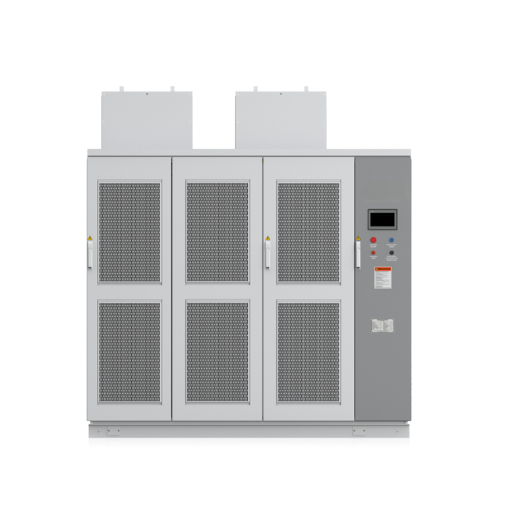
Static Frequency Converter (SFC): The Electronic Approach
A static frequency converter (SFC) starts large synchronous machines by acting as a variable-frequency generator. The SFC feeds the machine stator with precisely controlled voltage and frequency, accelerating the rotor from standstill to synchronous speed. Once at speed, the machine synchronizes to the grid and the SFC disconnects.
Modern SFC systems achieve approximately 97% inverter efficiency, excluding transformer losses. They provide fully controllable starting torque and acceleration profiles. This protects the machine from mechanical stress and eliminates the current inrush associated with direct-on-line starting.
SFCs are the standard for gas turbine starting in combined-cycle plants. A typical 200 MW gas turbine might use a 20-30 MW SFC to accelerate from zero to 3,000 RPM in 15-20 minutes. The SFC also provides excitation current during startup, simplifying the overall system.
For synchronous condensers, SFC starting enables rapid grid connection. A 200 MVAr synchronous condenser can reach synchronous speed and synchronize in approximately 20 minutes from a cold start. This responsiveness is critical for grid emergency support.
Pony Motor with VFD: The Mechanical Approach
The pony motor approach uses a smaller induction motor, typically 5-15% of the main machine rating, to accelerate the synchronous machine to near-synchronous speed. A VFD on the pony motor provides soft starting and speed control. Once the main machine approaches synchronous speed, excitation is applied and the unit pulls into synchronism.
Pony motors have been used for decades and remain common in certain applications. The hardware is familiar to plant maintenance staff. The pony motor can also serve as a backup for black-start capability if properly configured.
However, pony motors add rotating machinery that requires maintenance. Bearings, couplings, and clutches introduce failure modes that electronic SFCs do not have. The footprint is also larger, which can be problematic in retrofits where space is limited.
When Each Method Makes Sense
Most buyers assume SFC is always superior to pony motor for generator starting. In reality, the choice requires site-specific analysis.
Choose SFC when starting time is critical, when space is limited, when minimal maintenance is a priority, or when the starting duty is frequent. SFC is also preferred for new plants where the incremental cost can be optimized into the overall design.
Choose pony motor when retrofitting an existing plant that already has mechanical starting infrastructure, when maintenance staff are familiar with the technology, or when brushless excitation is preferred over static excitation with slip rings. Pony motors can also make sense when starting duty is infrequent and capital cost is the primary driver.
The table below summarizes the comparison.
| Factor | SFC | Pony Motor with VFD |
|---|---|---|
| Starting time | 15-20 min for large GT | 20-30 min |
| Footprint | Compact | Larger (motor + clutch) |
| Maintenance | Low (static equipment) | Moderate (rotating machinery) |
| Capital cost | Higher | Lower |
| Excitation | Static with slip rings | Brushless option available |
| Black-start capability | Requires separate system | Possible with pony motor |
Synchronous Condensers and Grid Support
Converting Retired Generators to Synchronous Condensers
As coal and nuclear plants retire worldwide, utilities face a growing challenge. These plants provided essential grid inertia and reactive power support. Removing them without replacement threatens grid stability.
The solution is converting retired generators to synchronous condensers. The turbine and boiler are removed. The generator remains, driven as a motor by grid power, spinning without producing real power but providing reactive power and inertia to the system.
This conversion is economically attractive compared to building new compensation equipment. The generator already exists. The foundation, cooling, and auxiliary systems can often be reused. The main additions are a starting system, modified excitation, and protection upgrades.
A European utility converted a 200 MW steam turbine generator to synchronous condenser operation after the plant’s emissions permit expired. The unit now provides 150 MVAr of dynamic reactive power support to a grid with 40% renewable penetration. The conversion cost was approximately 15% of a new synchronous condenser installation.
SFC Starting and Synchronization Sequence
Starting a synchronous condenser requires bringing a large inertia from standstill to synchronous speed, then synchronizing to the grid. The SFC sequence proceeds as follows.
First, the SFC energizes the stator with low-frequency voltage. The rotor begins to turn. Frequency and voltage increase gradually as speed rises. The SFC controls torque to maintain constant acceleration.
At approximately 95% of synchronous speed, the excitation system applies field current. The machine generates internal voltage. The SFC continues to accelerate the machine while synchronizing equipment monitors phase angle, frequency, and voltage magnitude.
When conditions match, the circuit breaker closes and the machine connects to the grid. The SFC de-energizes and disconnects. The synchronous condenser now operates in parallel with the grid, delivering or absorbing reactive power as commanded by the voltage regulator.
From start button to synchronization, a modern SFC system achieves this in approximately 20 minutes for a 200 MVAr unit. This is fast enough for emergency grid support and routine daily cycling.
Reactive Power and Inertia Services for Low-Inertia Grids
Renewable generation displaces synchronous machines, reducing system inertia. Low inertia makes grids vulnerable to frequency excursions following disturbances. A 2016 South Australia blackout demonstrated how quickly frequency can collapse when inertia is insufficient.
Synchronous condensers address this by providing two essential services. First, they deliver reactive power for voltage control. A single 200 MVAr condenser can regulate voltage across a wide area, reducing the need for switched capacitor banks.
Second, and more critically, they provide rotational inertia. The spinning mass of a synchronous condenser resists sudden frequency changes. This buys time for primary frequency response from generators and loads. Inertia from converted generators is particularly valuable because the units are large, typically 100-300 MVAr each.
Grid operators in the UK, Ireland, Australia, and several US ISOs are now procuring inertia and reactive power as separate ancillary services. This creates a revenue stream for synchronous condenser owners, improving project economics.
Grid-Forming Converters and Renewable Integration
From Grid-Following to Grid-Forming Control
Traditional grid-connected converters use grid-following control. They measure grid voltage and frequency and inject current in phase with the measured voltage. This works well when the grid is strong and synchronous machines dominate.
As inverter-based resources (wind, solar, batteries) proliferate, grid-following control becomes problematic. Weak grids with low short-circuit ratio can experience instability when grid-following inverters predominate. The converters chase each other, creating oscillations and potential collapse.
Grid-forming control solves this by making the converter behave like a voltage source, similar to a synchronous generator. The converter establishes its own internal voltage reference and frequency. Other sources synchronize to it. Grid-forming converters provide virtual inertia, voltage regulation, and fault ride-through capability that stabilizes weak grids.
Grid-forming converters are becoming essential for low-inertia grids with high renewable penetration. Several grid codes now require or incentivize grid-forming capability for new connections. This trend is expanding the addressable market for advanced converter control in power generation.
HVDC and Multi-Terminal Converter Networks
High voltage direct current (HVDC) converters are critical for long-distance transmission and asynchronous grid interconnection. The HVDC converter transformer market was valued at 816millionin2024andisprojectedtoreach816millionin2024andisprojectedtoreach1.03 billion by 2034, growing at 3.5% annually.
Voltage source converter (VSC) technology is the fastest-growing segment, expanding at 13.3% CAGR. VSC-HVDC uses modular multilevel converter (MMC) topology to synthesize AC voltage with low harmonic distortion. This enables independent control of active and reactive power, black-start capability, and connection to weak AC grids.
Multi-terminal HVDC networks connect multiple points rather than just two. These networks function like a DC transmission grid, enabling power routing between regions. Grid-forming control at each terminal ensures stable operation without reliance on strong AC systems. This is particularly relevant for offshore wind integration and cross-border renewable trading.
Battery Energy Storage with Grid-Forming Inverters
Battery energy storage systems (BESS) are increasingly paired with grid-forming inverters. A grid-forming BESS can establish and stabilize islanded microgrids, provide black-start services, and deliver fast frequency response.
The converter topology for grid-forming BESS is typically two-level or three-level voltage source inverters at medium voltage. Power ratings range from a few megawatts to 100+ MW for utility-scale installations. Integration with power plant auxiliary systems creates opportunities for hybrid configurations where a BESS provides both energy shifting and grid-forming services.
Grid-forming inverters must maintain power quality under all operating conditions. For harmonic mitigation strategies and IEEE 519 compliance approaches, see our MV drive power quality guide.
Converter Topology Selection for Power Generation
VSI vs LCI for Large Synchronous Motors
Voltage source inverter (VSI) and load commutated inverter (LCI) are the two dominant topologies for large power generation drives.
VSI uses a DC link with capacitors and self-commutated devices (IGBTs, IGCTs, or emerging SiC modules). The inverter synthesizes variable voltage and frequency output. VSI offers high dynamic performance, four-quadrant operation, and good power factor. It is the standard for general-purpose VFDs and is increasingly used for large synchronous motor starting.
LCI uses thyristors that rely on motor back-EMF for commutation. This eliminates the need for turn-off devices, enabling very high power ratings with mature, reliable technology. LCI has been the traditional choice for large synchronous motor starting and pumped storage.
However, LCI requires a synchronous motor or special induction motor design. It produces lower harmonics on the motor side but typically requires a larger input transformer and harmonic filters. VSI offers more flexibility but may require output filters for long motor cables.
Two-Level vs Modular Multilevel (MMC) Topologies
Two-level VSI is the simplest topology. Each phase switches between positive and negative DC bus voltage. For medium voltage, devices are series-connected to achieve required voltage ratings. Two-level drives are cost-effective up to approximately 5-7 kV and 10-15 MW.
The modular multilevel converter (MMC) generates a stepped voltage waveform which has minimal harmonic distortion through its use of multiple submodules. The submodule contains its own capacitor together with its own switching elements. The design of MMC enables it to operate at exceptionally high voltage and power capacities which makes it well suited for high voltage direct current systems and large pumped storage facilities.
Power plants with auxiliary systems that need less than 10 megawatts of power usually find two-level and cascaded H-bridge (CHB) topologies to be their most cost effective solution. Pumped storage systems at 50 megawatts and higher now prefer MMC because it delivers better waveform performance and unlimited system growth capabilities.
Wide Bandgap Semiconductors: SiC and GaN Impact
Silicon carbide (SiC) and gallium nitride (GaN) wide bandgap semiconductors are beginning to penetrate medium voltage converter markets. These devices switch faster, operate at higher temperatures, and have lower losses than silicon IGBTs.
For power generation applications, SiC offers particular promise in the 3.3-6.6 kV range. Higher switching frequencies enable smaller filters and transformers. Lower losses improve efficiency, particularly at part load where many auxiliaries operate. Reduced cooling requirements can be valuable in space-constrained installations.
Current limitations include device cost, voltage rating, and long-term reliability data at utility scale. For critical power generation applications, silicon-based technologies remain the conservative choice. However, SiC is advancing rapidly and will likely become competitive for new installations within the next five years.
Quick Topology Decision Table
| Application | Power Range | Preferred Topology | Notes |
|---|---|---|---|
| Boiler feed pump VFD | 1-12 MW | Two-level VSI or CHB | Cost-effective, proven |
| ID/FD fan VFD | 0.5-8 MW | Two-level VSI or CHB | High dynamic response |
| Gas turbine starting | 10-40 MW | LCI or VSI | LCI mature; VSI gaining share |
| Pumped storage CFSM | 50-200+ MW | Cycloconverter or MMC | Waveform quality critical |
| Pumped storage doubly-fed | 50-300 MW | Rotor-side converter | Partial-rated converter |
| Synchronous condenser start | 5-30 MW | LCI or VSI | Starting duty only |
| Grid-forming BESS | 1-100+ MW | Two-level or three-level VSI | Fast control loops required |
For a broader framework on vetting suppliers for power generation projects, see our manufacturer evaluation guide.
Energy Savings and ROI by Application
Quantified Savings: Pumps, Fans, and Compressors
The business case for power plant VFD retrofits rests on quantified energy savings. The following ranges represent typical results based on industry data and project reports.
Boiler feed pumps achieve 15-25% energy savings through VFD control. On a 10 MW pump, this is 1.5-2.5 MW reduction in auxiliary load. At 8,000 operating hours and 60/MWh,annualsavingsrangefrom60/MWh,annualsavingsrangefrom720,000 to $1,200,000.
ID and FD fans achieve 20-35% savings due to the cubic power law. A 5 MW fan set saving 25% reduces load by 1.25 MW. Annual savings at 8,000 hours reach $600,000.
Cooling water pumps achieve 15-30% savings. The wide range reflects varying cooling methods and ambient conditions. Plants with once-through cooling see lower savings than those with cooling towers, where fan and pump speed can both be optimized.
Payback Periods and TCO Analysis
Payback periods for power plant auxiliary VFD retrofits typically range from 18 months to 36 months. The exact figure depends on energy price, operating hours, and existing equipment condition.
A comprehensive total cost of ownership (TCO) analysis should include several factors beyond energy savings. Reduced maintenance from soft starting extends motor and pump life. Improved process control reduces thermal cycling and boiler tube fatigue. Lower emissions from optimized combustion may have regulatory value in some markets.
When evaluating TCO, also consider the cost of not upgrading. Many utilities face capacity constraints on aging plants. Auxiliary power reduction effectively increases net plant output without adding generation capacity. This capacity benefit can be more valuable than energy savings alone.
Ready to quantify savings for your plant? Contact our engineering team for a project-specific analysis of auxiliary load, operating profile, and retrofit economics.
Frequently Asked Questions
What voltage class should I specify for a power plant VFD?
Most power plant auxiliary motors operate at 3.3 kV, 4.16 kV, or 6.6 kV. Match the VFD voltage to the motor nameplate rating. For new installations, 6.6 kV is increasingly common for large drives because it reduces cable current and losses. Direct generator interface applications may require 11 kV or 13.8 kV.
How do I choose between SFC and pony motor for generator starting?
SFC is preferred when starting time matters, space is limited, maintenance minimization is a priority, or starting duty is frequent. Pony motors make sense for retrofits with existing mechanical infrastructure, infrequent starting, or when brushless excitation is required. The decision table in the Starting Large Synchronous Machines section above provides a detailed comparison.
Can variable-speed pumped storage regulate grid frequency in pump mode?
The technology of variable-speed pumped storage allows operations to control pumping power between the range of 30 percent and 30 percent of their maximum capacity. The plant uses this capability to increase power absorption during times of excess generation and to decrease power absorption during times of high demand on the grid. Fixed-speed plants cannot provide this service.
What is the typical payback for a boiler feed pump VFD retrofit?
Payback periods of 18 to 30 months are typical for boiler feed pump VFD retrofits. The savings matter because they depend on three variables which include pump size and operating hours and energy price and baseline efficiency. Plants with high operating hours and expensive electricity see the fastest payback.
Should I specify air-cooled or water-cooled for a power plant installation?
Air-cooled drives are simpler and require less infrastructure. Water-cooled drives offer higher power density and are quieter, which matters in some plant layouts. For power plant auxiliaries below 5 MW, air-cooled is usually adequate. Above 10 MW, water-cooled becomes increasingly attractive due to size and noise constraints.
Conclusion
Selecting the right high voltage frequency converter power generation solution requires matching topology to application, quantifying ROI for stakeholders, and treating grid integration as a system-level design challenge. Power plant auxiliaries, pumped storage, synchronous condensers, and grid-forming converters each demand different converter technologies and specifications.
The key is to start with the application requirements. Boiler feed pumps need efficient variable speed control. Pumped storage demands wide-range power conversion. Synchronous condensers require reliable starting systems. Grid-forming applications need advanced control algorithms. No single converter suits all of these needs.
Shandong Electric manufactures power conversion equipment for industrial, mining, oil and gas, power generation, and aviation applications. Our engineering team supports project-specific converter selection, from voltage class and topology through cooling and harmonic compliance. For complex power generation applications, custom engineering ensures the converter matches your exact grid code, motor specification, and control requirements.
Request a free power generation VFD specification review. Contact our engineering team with your application details, and we will recommend the optimal converter topology, voltage class, and configuration for your project.
Shandong Electric also offers our 400Hz frequency converter for ground power and aviation applications, manufactured with the same quality standards that support critical infrastructure worldwide.
