
A military aircraft ground power supply delivers regulated 400Hz AC power to military aircraft while they are parked on the flight line, in a hangar, or at a forward operating base. Unlike commercial airport ground power, military systems must comply with MIL-STD-704, survive extreme environments, and operate under Emissions Control (EMCON) conditions where any detectable signature can compromise mission security.
If you are a defense contractor, procurement officer, or base engineer specifying ground power equipment, the gap between commercial and military requirements is wider than most suppliers acknowledge. Commercial 400Hz units may meet voltage and frequency specs, but they rarely address the transient tolerance, electromagnetic compatibility, and tactical portability that military operations demand. This article breaks down every standard, specification, and procurement consideration you need to build the right power system for your airbase or expeditionary force.
Key Takeaways
- Military aircraft ground power supply systems must comply with MIL-STD-704F, which specifies 115V AC at 400Hz with strict transient and harmonic limits.
- Fighter aircraft (Category B) demand the tightest power quality, with voltage recovery within ±15V after load steps and THD below 3%.
- Tactical deployable units face operating temperatures from -32°C to +55°C and must minimize acoustic, thermal, and electromagnetic signatures.
- Solid state frequency converters are replacing diesel motor-generator sets in fixed installations and many tactical roles due to instant start, lower maintenance, and EMCON advantages.
- Procurement specifications should state MIL-STD-704 aircraft category, kVA rating, environmental range, EMI compliance, and support package requirements.
What Is a Military Aircraft Ground Power Supply?
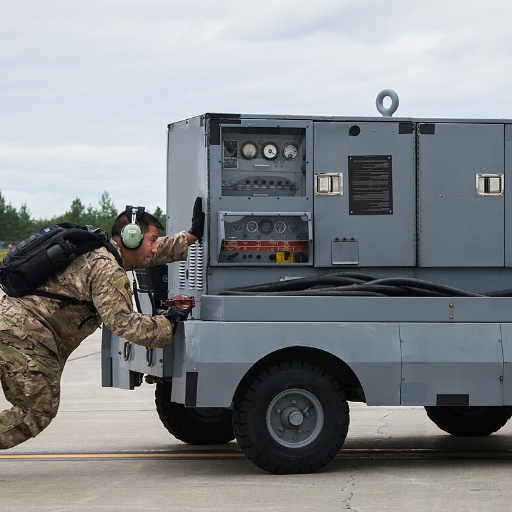
A military aircraft ground power supply is a system that provides clean, regulated 400Hz AC electrical power to military aircraft when their engines are not running and their onboard generators are offline. The system takes input power from the local grid, a diesel generator, or another source, converts it to the precise voltage and frequency profile the aircraft requires, and delivers it through a ground power cable and connector.
The basic function is identical to commercial airport ground power: keep the aircraft energized for maintenance, pre-flight checks, avionics testing, and system startup. The military application adds layers of complexity that commercial systems rarely face. These include compliance with MIL-STD-704 power quality standards, operation in extreme climates, compatibility with multiple aircraft types from fighters to heavy transports, and the ability to deploy rapidly to austere locations with minimal infrastructure.
For a defense procurement officer reviewing quotes, the difference between a commercial 400Hz GPU and a military-specification unit can mean the difference between reliable flight line operations and avionics damage, mission delays, or equipment returns.
Need help specifying a military aircraft ground power supply for your airbase or defense project? Contact our defense systems engineering team for MIL-STD-compliant quotations and technical consultation. For a deeper explanation of how aircraft ground power systems work, including output tolerances and interlock standards, see our aircraft ground power frequency converter guide.
MIL-STD-704: The Power Quality Standard That Governs Everything
What MIL-STD-704 Specifies
MIL-STD-704 is the Department of Defense standard that defines the characteristics of aircraft electric power provided at the interface between the aircraft and the ground power unit. If your military aircraft ground power supply does not meet MIL-STD-704, it does not meet the requirement. Full stop.
The standard specifies:
- Nominal voltage: 115V AC line-to-neutral, 200V line-to-line for three-phase systems
- Nominal frequency: 400Hz
- Frequency tolerance: ±5Hz (395 to 405Hz acceptable)
- Voltage regulation: Steady-state voltage must remain within ±3% of nominal (111.5V to 118.5V for 115V systems)
- Voltage transients: For Category B aircraft, the voltage must recover to within ±15V of nominal within specified time limits after a load step
- Harmonic distortion: Total harmonic distortion (THD) must remain within defined limits, typically below 5% for most applications
- Phase imbalance: Three-phase systems must maintain balanced voltages within specified tolerances
These limits exist for a reason. Military aircraft avionics, flight control systems, radar, and communication equipment are designed to operate within these envelopes. Exceed the transient limit during engine start simulation, and you risk damaging a million-dollar radar system.
MIL-STD-704 Revisions (A Through F)
The standard has evolved through multiple revisions since the 1950s. MIL-STD-704F, released in 2016, is the current revision and supersedes all earlier versions. Key changes across revisions tightened transient limits, expanded the number of aircraft categories from the original three to five (Categories A through E), and refined harmonic distortion requirements.
For procurement purposes, always specify MIL-STD-704F compliance. Referencing an older revision in a tender document invites obsolete equipment or requires the supplier to validate against a superseded standard.
Aircraft Categories Explained
MIL-STD-704F defines five aircraft categories based on the sensitivity of their electrical systems and the severity of their power demands:
| Category | Aircraft Type | Key Power Quality Requirement |
|---|---|---|
| Category A | Large transports and tankers (C-5, KC-135) | Moderate transient limits, high continuous load |
| Category B | Fighter and attack aircraft (F-16, F/A-18, F-35) | Tightest transient limits, highest peak demand |
| Category C | Helicopters (AH-64, CH-47, UH-60) | Specific start-up surge profiles |
| Category D | Patroller and trainer aircraft | Standard limits, lower power |
| Category E | UAVs and small aircraft | Simplified requirements |
The category matters more than most buyers realize. A ground power unit rated for Category A transport aircraft may fail catastrophically when connected to a Category B fighter during full avionics startup. The fighter’s simultaneous demand from radar, flight computers, and weapon systems creates a load step that a Category A-rated unit cannot handle.
When Colonel Aminou Bello’s engineering team at a West African air force base connected a commercially sourced 90 kVA GPU to their F-16 fleet, they discovered the unit could not maintain voltage during the avionics initialization sequence. The voltage sagged below 100V, triggering automatic protective shutdowns on the aircraft. Only after specifying a MIL-STD-704 Category B-compliant solid state unit with active transient compensation did the flight line operate without interruption.
Aircraft-Specific Ground Power Requirements
Power Requirement Table
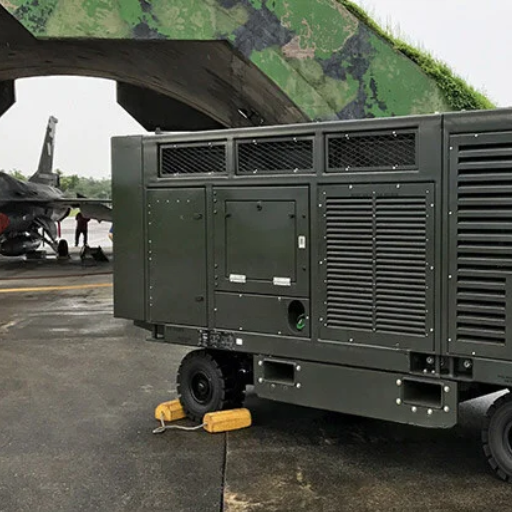
Different military aircraft draw different amounts of ground power depending on their size, electrical system architecture, and the operational mode during ground connection.
| Aircraft | Power (kVA) | Phase | Category | Notes |
|---|---|---|---|---|
| F-16 Fighting Falcon | 60-90 | 3-phase | B | High transient during radar and avionics startup |
| F-35 Lightning II | 90-120 | 3-phase | B | Highest peak demand of any operational fighter |
| F/A-18 Super Hornet | 60-90 | 3-phase | B | Naval variant with carrier-specific connectors |
| C-130 Hercules | 60-90 | 3-phase | A | Sustained high load for cargo systems |
| C-17 Globemaster III | 120-180 | 3-phase | A | Very high continuous load, lower transient |
| CH-47 Chinook | 45-60 | 3-phase | C | Helicopter-specific surge profile |
| AH-64 Apache | 30-45 | 3-phase | C | Lower continuous, high start-up surge |
| P-8 Poseidon | 60-90 | 3-phase | A | Maritime patrol, naval connector standards |
| A-400M Atlas | 90-120 | 3-phase | A | European transport, NATO compatibility |
| E-3 Sentry (AWACS) | 90-120 | 3-phase | A | High load from mission systems |
Why Requirements Vary
Fighter aircraft create the most demanding power profiles. When an F-35 pilot initiates the full avionics power-up sequence, the aircraft draws a sustained 90 kVA base load with transient spikes that push instantaneous demand above 120 kVA. The ground power unit must absorb this spike without allowing voltage to sag outside the MIL-STD-704 envelope.
Transport aircraft like the C-17 present a different challenge. Their ground power demand is high and continuous (120-180 kVA) but relatively stable. The unit must deliver sustained high power for extended periods during cargo loading, pre-flight checks, and engine start preparation.
Helicopters introduce surge profiles unique to their starter-generator systems. The CH-47’s electrical system draws a sharp current surge during rotor brake release and initial systems activation that lasts only a few seconds but peaks at 2-3 times the continuous rating.
Fixed Installation vs Deployable Tactical Units
Fixed Hangar and Flight Line Power
Permanent military aircraft ground power supply installations at established airbases typically use centralized solid-state frequency converters feeding multiple aircraft parking positions through a 400Hz distribution network. A single 500-1000 kVA converter station can supply power to 6-12 aircraft positions through underground or overhead distribution cables.
Fixed installations offer the highest reliability, lowest per-aircraft operating cost, and best power quality. They operate from a stable grid input, use large output filters for ultra-low THD, and provide redundant cooling and control systems. Maintenance is centralized, and the system operates continuously during flight line hours with minimal attention.
The primary drawback is infrastructure dependency. Fixed systems require a reliable grid connection, substantial electrical room space, and distribution cabling to each aircraft position. They cannot relocate if the squadron deploys.
Deployable and Expeditionary Ground Power
Tactical military operations require ground power that moves with the aircraft. Deployable units fall into two categories: diesel motor-generator sets and transportable solid-state frequency converters.
Diesel motor-generator sets remain common in expeditionary roles because they generate their own power from readily available fuel. A typical tactical diesel GPU consists of a diesel engine directly coupled to a 400Hz generator, packaged in a towable trailer or skid-mounted frame. These units range from 30 kVA for helicopter support to 180 kVA for heavy transport aircraft.
Transportable solid state frequency converters take a different approach. They require an external power source, typically a diesel generator or grid connection, but convert that power with higher efficiency and better quality than a motor-generator set. Modern tactical solid state units are packaged in ISO containers or ruggedized shelters that can be air-dropped, truck-mounted, or transported by helicopter.
At a coalition forward operating base in the Middle East, Sergeant Yuki Tanaka’s team had four hours to establish 400Hz power for eight F-16s arriving for a temporary deployment. Their solution: two containerized 500 kVA solid state frequency converters connected to existing diesel generator sets. The containers arrived by C-130, were offloaded by forklift, and were producing MIL-STD-704 compliant power within three hours of touchdown. A comparable motor-generator deployment would have required crane rigging, foundation preparation, and multiple days of alignment and testing.
Solid State vs Diesel GPU for Military Applications
Diesel Motor-Generator Sets
Diesel GPUs have been the military standard for decades. Their advantages are straightforward: they generate their own power from JP-8 or diesel fuel, require no external electrical infrastructure, and can be field-repaired by any competent mechanic with standard tools and spare parts.
The disadvantages have become more significant as military requirements have evolved:
- Noise: 80-95 dB at 1 meter, requiring hearing protection and creating acoustic detection risk
- Emissions: Exhaust gases produce a thermal and chemical signature
- Start time: 30-60 seconds from cold start to stable 400Hz output
- Maintenance: Brush and bearing replacement, oil changes, filter replacement, vibration monitoring
- Fuel logistics: Continuous fuel supply required for sustained operations
- Power quality: Voltage regulation typically ±3-5%, THD 3-5%, frequency stability ±1%
Solid State Frequency Converters
Static frequency converter technology has reached maturity for military applications. Modern tactical solid state units offer:
- Instant start: Power available within 1 second of activation
- Silent operation: 55-65 dB, comparable to normal conversation
- No exhaust: Zero thermal or chemical emissions from the converter itself
- Superior power quality: Voltage regulation ±1%, THD below 2%, frequency stability ±0.1%
- Lower maintenance: No brushes, bearings, or engine components to service
- EMCON advantage: Minimal electromagnetic and acoustic signature
The trade-off is input power dependency. A solid state converter needs a reliable AC or DC input, typically from a generator or grid. It cannot operate independently like a diesel set. However, when paired with a standard diesel generator for the input source, the combination delivers better power quality than a motor-generator set while maintaining field independence.
For airport 400Hz ground power applications, solid state has already become the dominant technology. The military transition is following the same path, driven by reliability, maintenance reduction, and operational signature concerns.
EMCON and Stealth Considerations
EMCON, short for Emissions Control, refers to operational conditions where a military force minimizes all detectable emissions to avoid enemy detection. This includes radio silence, radar shutdown, and the elimination of any acoustic, thermal, or electromagnetic signatures that could reveal position.
Ground power equipment directly impacts EMCON posture. A diesel motor-generator set produces three detectable signatures: acoustic noise from the engine and exhaust, thermal emissions from the engine block and exhaust gases, and electromagnetic emissions from the generator and ignition system. In a contested environment, these signatures can reveal an aircraft’s ground position to enemy sensors from distances of several kilometers.
A solid state frequency converter fed by a remotely located power source produces none of these signatures at the aircraft position. The converter itself emits minimal electromagnetic noise (with proper shielding and filtering), negligible acoustic noise, and no thermal exhaust. When paired with underground or shielded power distribution, the aircraft can receive full ground power while maintaining near-zero detectable signature.
For special operations and forward air refueling points, this advantage is decisive. A special operations team operating a covert forward arming and refueling point cannot afford the acoustic signature of a diesel generator running continuously while aircraft are on the ground. Solid-state converters, powered by batteries or a remotely located generator, eliminate this vulnerability.
Procurement officers should specify MIL-STD-461 electromagnetic compatibility in addition to MIL-STD-704 when EMCON operations are anticipated. MIL-STD-461 defines conducted and radiated emission limits that ensure the ground power unit itself does not become a radio frequency beacon.
NATO and International Military Standards
Military aircraft ground power supply requirements extend beyond US MIL-STD-704 for international operations. NATO standardization agreements ensure that allied forces can share airfields, ground support equipment, and logistical resources.
NATO STANAG 7003 defines the electrical interface between ground support equipment and NATO aircraft. It aligns closely with MIL-STD-704F but includes additional provisions for European aircraft types and connector standards. Any military aircraft ground power supply intended for NATO operations should comply with both standards.
DEF STAN 61-5 (UK) is the British military equivalent, used by the Royal Air Force and Royal Navy. It specifies similar voltage and frequency requirements with British environmental testing standards.
GAM-EG 13 (France) governs French military aircraft electrical interfaces. French defense procurement typically references this standard for domestic programs while accepting NATO STANAG 7003 for coalition equipment.
The practical implication for international defense contractors and non-US manufacturers is significant. A ground power unit designed exclusively to MIL-STD-704 may encounter compatibility issues at NATO shared facilities or when supporting allied aircraft. Shandong Electric designs military-specification converters to comply with MIL-STD-704F, NATO STANAG 7003, and DEF STAN 61-5 simultaneously, ensuring unrestricted compatibility across allied defense markets.
Procurement and Specification Guidance
Technical Requirements to Specify
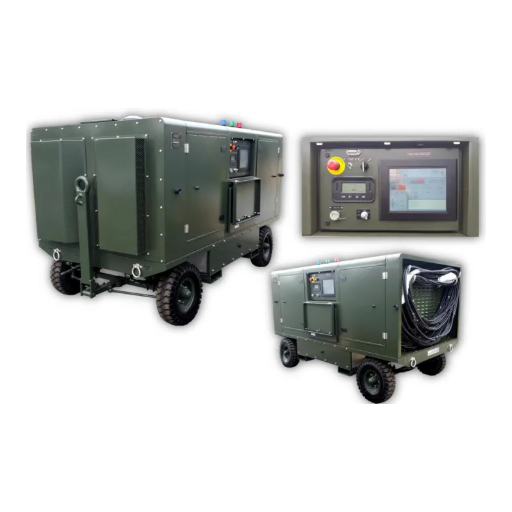
A defense tender for military aircraft ground power supply equipment should include these technical parameters:
- MIL-STD-704F compliance: State the aircraft category (A, B, C, D, or E) explicitly
- Output specification: 115V AC line-to-neutral, 200V line-to-line, 400Hz, 3-phase
- Power rating: Continuous kVA and peak kVA (typically 1.3-1.5x continuous for fighter applications)
- Voltage regulation: ±1% or better from no-load to full-load
- Frequency stability: ±0.1% or better under load variation
- THD: Maximum 3% total harmonic distortion, preferably below 2% for Category B
- Transient response: Recovery to within ±15V within the specified time after 100% load step
- Operating temperature: -32°C to +55°C for tactical units; -20°C to +50°C for fixed installations
- EMI/EMC: MIL-STD-461 compliance for conducted and radiated emissions
- Environmental: MIL-STD-810 testing for shock, vibration, humidity, salt spray, and sand/dust
Logistics and Support Requirements
Power quality specifications mean nothing if the unit cannot be maintained in the field. Specify:
- MTBF: Minimum 10,000 hours for tactical units, 50,000+ hours for fixed installations
- MTTR: Less than 30 minutes for field-replaceable units using standard tools
- Documentation: Technical manuals, illustrated parts breakdown, training materials
- Spares package: Recommended initial spares including filters, fuses, fans, and control modules
- Warranty: Minimum 24 months, with option for extended field service support
Export and Compliance Considerations
Defense equipment procurement involves export control complexity. US-origin components, including certain semiconductors and control systems, may fall under ITAR (International Traffic in Arms Regulations) or EAR (Export Administration Regulations). These controls restrict re-export, require end-user certifications, and can add months to delivery timelines.
Non-US manufacturers can offer significant advantages for international defense buyers. Equipment designed without US-controlled technology avoids ITAR/EAR restrictions entirely, enabling faster delivery and simpler logistics. Shandong Electric’s military-specification frequency converters are engineered with non-controlled components, allowing unrestricted export to allied defense forces worldwide without US State Department or Commerce Department licensing delays.
| Specification | Diesel Motor-Generator | Solid State Frequency Converter |
|---|---|---|
| Start time | 30-60 seconds | <1 second |
| Noise at 1 meter | 80-95 dB | 55-65 dB |
| Voltage regulation | ±3-5% | ±1% |
| Frequency stability | ±1% | ±0.1% |
| THD | 3-5% | <2% |
| Maintenance (annual) | 8,000−8,000−15,000 | 1,000−1,000−2,000 |
| Field repairability | High (mechanical) | Moderate (modular boards) |
| EMCON signature | High (acoustic, thermal, EM) | Low (minimal detectable signature) |
| Fuel dependency | Direct (onboard fuel tank) | Indirect (requires external power source) |
Conclusion
Military aircraft ground power supply requirements go far beyond voltage and frequency ratings. MIL-STD-704F compliance, aircraft category matching, environmental survivability, and operational signature control are all essential considerations that separate military-grade equipment from commercial adaptations.
The shift from diesel motor-generator sets to solid-state frequency converters is accelerating across fixed installations and tactical deployments. The combination of instant start, superior power quality, reduced maintenance, and EMCON compatibility makes solid state the preferred technology for modern military air operations.
When writing specifications, be precise. State the MIL-STD-704 aircraft category, the continuous and peak kVA requirements, the environmental operating range, and the EMI compliance standard. A procurement officer who includes these parameters will receive comparable, qualified quotations from all bidders and avoid the cost and schedule impact of discovering non-compliance after delivery.
Ready to specify a MIL-STD-704 compliant military aircraft ground power supply for your base or defense project? Contact Shandong Electric for technical consultation, aircraft-specific power analysis, and competitive quotations built around your exact operational requirements.
