
A GPU frequency converter is a specialized static frequency converter that transforms standard grid power into 400Hz aircraft-quality electricity for ground support operations. Selecting the right unit means matching the converter’s kVA rating to your aircraft fleet, choosing between AC-only and dual AC/DC output, and planning for environmental conditions and future fleet changes.
Most procurement mistakes happen because buyers confuse kW with kVA, oversize units “just to be safe,” or forget to account for inrush current during engine start. These errors cost airports thousands of dollars per gate and can leave aircraft without adequate power when they need it most.
This guide provides a complete sizing and selection methodology for GPU frequency converters. You will learn how aircraft power ratings work, how to size a unit for your fleet, and how to write a specification that gets comparable quotes from suppliers.
Key Takeaways
- GPU frequency converters are rated in kVA (apparent power), not kW (real power), because aircraft electrical systems have power factors of 0.8-0.9 that must be accounted for in sizing.
- A Boeing 737 needs 90 kVA, a B777 needs 180 kVA, and an A380 needs 270 kVA. Specifying the wrong rating wastes 15,000−15,000−25,000 per gate.
- Inrush current during engine start can reach 1.5-2x continuous power for 10-30 seconds. Your GPU must handle this surge without tripping.
- Dual AC/DC GPUs cost 25-40% more than AC-only units. You only need 28VDC output if you serve military aircraft or certain business jets.
- A well-written RFP with a complete specification checklist produces comparable quotes and prevents suppliers from cutting corners on output quality or protection features.
Understanding GPU Power Ratings: kVA vs kW
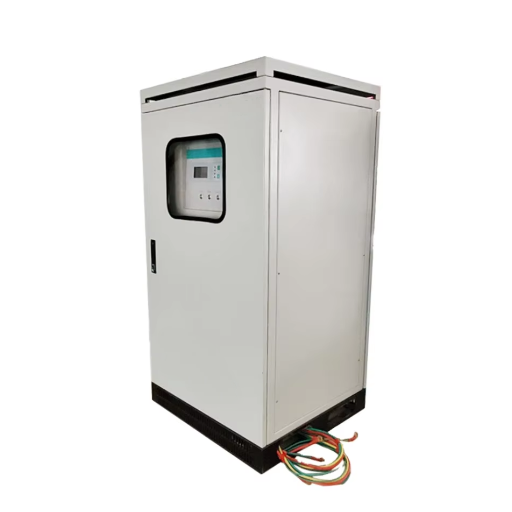
Why kVA Matters More Than kW for Aircraft Power
Aircraft electrical systems are not purely resistive. They contain transformers, motors, and avionics that create reactive power. This means the power factor, the ratio of real power (kW) to apparent power (kVA), is typically 0.8 to 0.9 for most aircraft.
When a GPU manufacturer rates a unit at 90 kVA, they are specifying the apparent power capacity. The real power delivered to the aircraft is lower. At a power factor of 0.85, a 90 kVA GPU delivers approximately 76.5 kW of usable power. If you size based on kW alone and ignore power factor, you will undersize the unit.
This is why all aviation standards, including ISO 6858 and MIL-STD-704F, specify power requirements in kVA or volt-amps. The GPU must be capable of supplying both the real and reactive components of the aircraft load.
kVA to kW Conversion
| GPU Rating (kVA) | At 0.80 PF (kW) | At 0.85 PF (kW) | At 0.90 PF (kW) |
|---|---|---|---|
| 45 | 36.0 | 38.3 | 40.5 |
| 60 | 48.0 | 51.0 | 54.0 |
| 90 | 72.0 | 76.5 | 81.0 |
| 120 | 96.0 | 102.0 | 108.0 |
| 180 | 144.0 | 153.0 | 162.0 |
| 270 | 216.0 | 229.5 | 243.0 |
The power factor of a specific aircraft depends on its electrical load profile. A parked aircraft with cabin lighting and ventilation running might operate at 0.8 power factor. During engine start, when starter motors draw heavy inductive current, the power factor can drop to 0.7 or lower. A quality GPU frequency converter must maintain rated output voltage and frequency across this range.
Sizing by Aircraft Type
Commercial Aircraft Power Requirements
The starting point for any GPU selection is a clear understanding of what aircraft you serve. Different aircraft types have dramatically different ground power needs.
| Aircraft Type | Typical GPU Rating | Notes |
|---|---|---|
| Regional jets (CRJ900, ERJ-175) | 60 kVA | Some models accept 45 kVA at smaller airports |
| Narrow-body (B737-800, A320neo) | 90 kVA | Most common requirement worldwide |
| Narrow-body MAX/NEO variants | 90 kVA | Electrical systems similar to prior generation |
| Wide-body (B777-300ER, A350-900) | 180 kVA | Higher draw due to larger cabin systems |
| Wide-body (B787, A330) | 180 kVA | Efficient electrical systems but still need 180 kVA |
| Super wide-body (A380) | 270 kVA | Typically uses two 180 kVA GPUs in parallel |
| Business jets (Gulfstream, Global) | 45-60 kVA | Often require dual AC + 28VDC |
| Military fighters (F-16, F/A-18) | 60 kVA | Require dual AC/DC output |
Load Type Considerations
For a deeper explanation of how aircraft ground power systems work, including output tolerances and interlock standards, see our aircraft ground power frequency converter guide.
Aircraft electrical loads fall into three categories. Resistive loads, such as cabin heaters and incandescent lighting, draw current in phase with voltage and do not create reactive power. Inductive loads, such as motors and transformers, draw current that lags voltage and create the reactive power that makes kVA sizing necessary. Rectifier loads, such as modern avionics and LED lighting power supplies, draw current in pulses and can introduce harmonic distortion.
The most demanding load condition is engine start. A jet engine starter motor is a large inductive load that can draw 1.5 to 2 times the aircraft’s continuous power rating for 10 to 30 seconds. A 90 kVA GPU serving a narrow-body aircraft must deliver 135 to 180 kVA momentarily during engine start without voltage collapse or frequency droop beyond allowable limits.
This is why GPU frequency converters are specified with both continuous and overload ratings. A typical 90 kVA unit is designed for 150% overload for 60 seconds, which covers the engine start requirement with margin.
Need help sizing a GPU for your specific fleet? Our engineering team can review your aircraft mix and recommend the optimal rating. Contact us for a free sizing assessment.
Step-by-Step GPU Selection Process
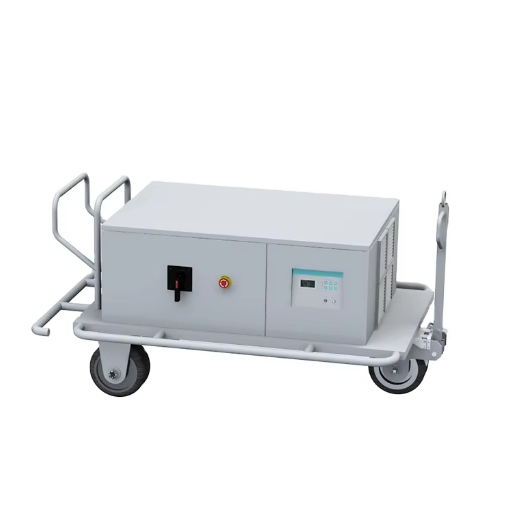
Step 1: Identify Your Aircraft Fleet
List every aircraft type that will use the GPU. Do not average or guess. If your gate serves both A320s and A350s, you must size for the larger aircraft. Record the manufacturer and model for each type.
Step 2: Determine Fixed vs Mobile Requirements
Fixed installations at gates require weatherproof cabinets and permanent mounting. For guidance on airport infrastructure architecture, see our airport 400Hz power supply design guide. Mobile units on towable carts need no civil works but require grid outlets at each stand. The choice affects enclosure rating, cable length, and environmental specifications.
Step 3: Choose AC-Only or Dual AC/DC Output
Commercial airliners need only 400Hz AC. Military aircraft, some business jets, and certain maintenance procedures require 28VDC in addition to 400Hz AC. A dual-output GPU contains both a static frequency converter and a 28VDC rectifier in one enclosure. The cost premium is 25-40% over an AC-only unit.
Step 4: Specify Power Rating with Margin
Size the continuous rating for the largest aircraft in your fleet. Add 10-20% margin above the aircraft’s nominal requirement. For a gate serving B737 aircraft rated at 90 kVA, specify a 90 kVA GPU. The built-in 150% overload capability handles engine start. Do not oversize to 120 kVA “just to be safe.” The extra capacity wastes money and provides no operational benefit.
Step 5: Define Output Quality Requirements
Specify voltage tolerance, frequency stability, and total harmonic distortion (THD). For commercial aviation, ISO 6858 requires +/- 3V and +/- 0.1% frequency. Premium static converters achieve +/- 2V and +/- 0.01% frequency with THD below 2%. The tighter your specification, the more comparable your quotes will be.
Step 6: Select Environmental and Installation Features
Specify IP rating, ambient temperature range, cooling method, and noise limits. Outdoor installations in tropical climates need IP54 minimum, 40C ambient rating, and sun shields. Indoor hangar units can use IP22 and standard ambient ratings.
Step 7: Plan for Future Fleet Changes
If you expect to upgrade from narrow-body to wide-body service within 10 years, size the infrastructure (cables, distribution) for the larger aircraft even if you install a smaller GPU today. Upgrading the converter itself is simple. Replacing cables and switchgear is expensive.
Worked Example: 4-Gate Regional Airport GPU Specification
Consider a regional airport in Southeast Asia with four gates serving a mixed fleet. The procurement team, led by facilities manager David Chen, needs to specify GPU frequency converters for a retrofit project replacing diesel units. For a detailed comparison of static and rotary converter technologies, see our static converter vs rotary converter analysis.
The aircraft mix is straightforward. Gates 1 and 2 serve A320 and B737 narrow-body aircraft. Gate 3 serves A330 wide-body aircraft on peak days. Gate 4 is flexible, handling either narrow-body or wide-body depending on schedule.
David starts with the aircraft power table. Narrow-body aircraft need 90 kVA. Wide-body aircraft need 180 kVA. The flexible gate must handle the worst case, which is 180 kVA.
He then considers output type. The airport serves only commercial airlines, so AC-only output is sufficient. No military or business jets use these gates. This eliminates the 25-40% premium for dual AC/DC units.
For environmental conditions, the airport is in a tropical climate with ambient temperatures reaching 40C. The units will be installed in outdoor cabinets at each gate. David specifies IP54 enclosures, forced-air cooling with tropical-grade filters, and UV-resistant cable assemblies.
For output quality, he specifies commercial-grade performance: 115/200V +/- 2V, 400Hz +/- 0.01%, and THD below 2%. This exceeds ISO 6858 minimums and ensures reliable operation even during engine start.
The final specification is clean and unambiguous.
| Parameter | Gates 1-2 | Gate 3 | Gate 4 (Flexible) |
|---|---|---|---|
| Aircraft type | A320, B737 | A330 | A320 through A330 |
| Continuous rating | 90 kVA | 180 kVA | 180 kVA |
| Overload capability | 150% for 60 sec | 150% for 60 sec | 150% for 60 sec |
| Output voltage | 115/200V AC | 115/200V AC | 115/200V AC |
| Output frequency | 400Hz +/- 0.01% | 400Hz +/- 0.01% | 400Hz +/- 0.01% |
| Voltage tolerance | +/- 2V | +/- 2V | +/- 2V |
| THD | <2% | <2% | <2% |
| Output type | AC only | AC only | AC only |
| Enclosure | IP54 outdoor | IP54 outdoor | IP54 outdoor |
| Ambient rating | 40C | 40C | 40C |
| Quantity | 2 units | 1 unit | 1 unit |
The total project requires four GPU frequency converters: two at 90 kVA and two at 180 kVA. David includes this table in his RFP, ensuring every supplier quotes to the same specification.
Dual AC/DC GPU Considerations
When You Need 28VDC Output
Not every aircraft operates on 400Hz AC alone. Military fighter aircraft require 28VDC for avionics and engine starting. Some business jets use 28VDC for ground operations. Certain maintenance procedures on commercial aircraft also need DC power for system testing.
If your operation serves military customers or operates a mixed civilian-military hangar, dual-output GPUs are essential. If you serve only commercial airlines, AC-only is the smarter and more economical choice.
Dual-Output GPU Architecture
A dual AC/DC GPU contains two independent power paths. The 400Hz AC path uses the standard AC-DC-AC static converter architecture with IGBT inversion and output filtering. The 28VDC path uses a separate rectifier stage that converts grid AC into regulated 28VDC, often with a battery backup for transient load support.
The two outputs are isolated and can operate simultaneously or independently. The AC output feeds the aircraft’s main electrical bus. The DC output feeds the aircraft’s DC bus through a separate connector.
The cost premium for dual-output units is significant but still lower than buying separate AC and DC ground power units. For a mixed-fleet operation, the dual-output approach also saves apron space and reduces the number of cables and connectors ground crews must manage.
Specification Checklist for RFPs
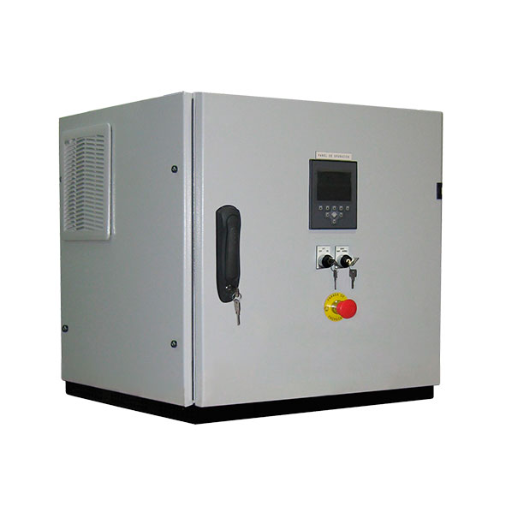
A well-written RFP produces comparable quotes and prevents suppliers from substituting lower-grade components. Use this checklist as the foundation for your procurement document.
Electrical Specifications
| Item | Specification | Notes |
|---|---|---|
| Input voltage | 380V or 480V AC, 3-phase, 50/60Hz | Match local grid |
| Input frequency | 50Hz or 60Hz | Specify actual local frequency |
| Output voltage | 115/200V AC, 3-phase | Line-to-neutral / line-to-line |
| Output frequency | 400Hz +/- 0.01% | Steady-state tolerance |
| Voltage regulation | +/- 2V at aircraft receptacle | Tighter than ISO 6858 minimum |
| Frequency stability | +/- 0.01% under all load conditions | Includes 0-100% load swing |
| THD | <2% | Total harmonic distortion |
| Power rating | [Specify kVA] | Continuous rating |
| Overload capacity | 150% for 60 seconds | For engine start |
| Power factor range | 0.7 lagging to 0.9 leading | Cover all aircraft load types |
| Efficiency | >93% at rated load | Static converter efficiency |
Mechanical and Environmental Specifications
| Item | Specification | Notes |
|---|---|---|
| Enclosure rating | IP54 minimum | Outdoor installation |
| Ambient temperature | -10C to +40C standard; specify if extreme | Tropical or arctic climates |
| Cooling | Forced air with replaceable filters | Specify filter grade |
| Noise level | <65 dB at 1 meter | Airport noise requirements |
| Dimensions | [Specify max] | Gate space constraints |
| Weight | [Specify max] | Pier mounting load limits |
| Cable length | 15 meters standard; specify if longer | Aircraft connection distance |
Safety and Protection Features
| Item | Specification | Notes |
|---|---|---|
| Overvoltage protection | Trip at 125V L-N | Protect aircraft bus |
| Undervoltage protection | Trip at 105V L-N | Detect cable fault |
| Overcurrent protection | 110% continuous, 150% time-limited | Coordinate with aircraft breaker |
| Short-circuit protection | Instantaneous trip | Protect converter and cables |
| Ground fault detection | <30mA sensitivity | Safety requirement |
| Interlock circuit | 28VDC Pins E/F compliant | Prevents live disconnection |
| Emergency stop | Remote pushbutton | Ground crew safety |
Standards and Certifications
| Item | Specification | Notes |
|---|---|---|
| Commercial compliance | ISO 6858 | Baseline for all units |
| Military compliance | MIL-STD-704F | If serving military aircraft |
| EMC | IEC 61000-6-2, IEC 61000-6-4 | Electromagnetic compatibility |
| Electrical safety | IEC 61439-1 | Low-voltage switchgear |
| Quality management | ISO 9001 | Manufacturer certification |
Documentation and Support Requirements
| Item | Specification | Notes |
|---|---|---|
| Technical manual | English, hard copy and PDF | Operation and maintenance |
| Wiring diagrams | Provided | Installation reference |
| Test certificates | Factory test report per unit | Verify performance before shipment |
| Spare parts list | 2-year recommended spares | Fan filters, contactors |
| Warranty | 24 months minimum | Parts and labor |
| Training | On-site operator training | 1 day typical |
| Technical support | 24/7 phone and email | Critical for airport operations |
Supplier Evaluation Criteria
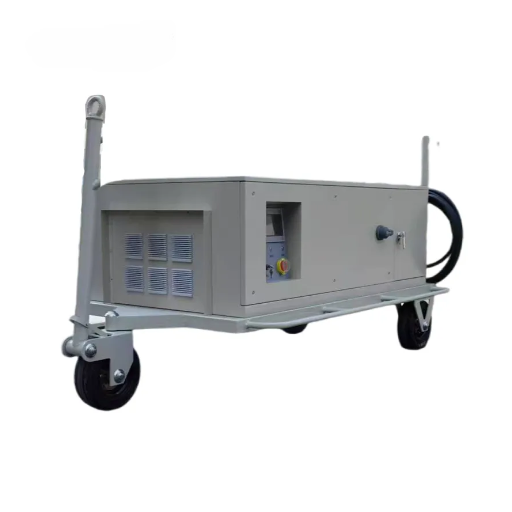
Price is important, but it should not be the only factor. Use this framework to evaluate GPU frequency converter suppliers on technical and commercial merit.
Technical Capability Assessment
Does the supplier manufacture static converters in-house, or do they source power modules from third parties? In-house design and manufacturing indicates deeper technical expertise and faster support response. Can the supplier provide customization for your specific voltage, frequency, or environmental requirements? A supplier with their own engineering team can adapt standard designs. Does the supplier have experience with airport and aviation applications? Aviation-grade units differ significantly from industrial frequency converters in output filtering, connector standards, and protection systems.
Manufacturing Quality and Certifications
Verify ISO 9001 certification as a baseline. Check whether the supplier conducts full-load factory testing on every unit. Some manufacturers test only sample units or rely on design verification. Ask for a factory test report from a recent shipment to verify testing depth.
After-Sales Support and Spare Parts
Airports operate 24/7. A GPU failure during peak hours is a critical incident. Evaluate the supplier’s support availability, spare parts inventory location, and typical response time. A supplier with a local distributor or regional warehouse can deliver spare parts in days rather than weeks.
Customization Flexibility
Can the supplier modify connector types, cable lengths, or control interfaces to match your existing infrastructure? Standard units with fixed configurations may require costly adapter cables or interface modifications during installation.
References and Track Record
Request references from airport customers in similar climates and operational environments. A supplier with 50 airport installations in Southeast Asia understands tropical conditions better than one whose experience is limited to temperate European airports.
Frequently Asked Questions
What size GPU do I need for a Boeing 737?
A Boeing 737 requires a 90 kVA GPU frequency converter. This rating covers the aircraft’s continuous ground power demand of approximately 60-70 kVA with margin for inrush current during engine start. Do not specify a 120 kVA unit for a B737. The extra capacity provides no operational benefit and costs approximately $15,000 more per gate.
Can one GPU serve multiple aircraft?
A single fixed GPU serves one aircraft at a time. A centralized converter system with distribution can serve multiple gates simultaneously, provided the total load does not exceed the converter’s rated capacity. For point-of-use installations, each gate needs its own GPU. Mobile GPUs can be moved between stands but only serve one aircraft at a time.
What is the difference between kVA and kW in GPU ratings?
kVA is apparent power, which includes both real power (kW) and reactive power. Aircraft electrical systems have power factors of 0.8-0.9, meaning a 90 kVA GPU delivers approximately 72-81 kW of real power. GPU manufacturers rate in kVA because that is what the aircraft electrical system demands. Always size in kVA, never in kW.
Do I need a dual AC/DC GPU or AC-only?
You need dual AC/DC output only if you serve military aircraft, certain business jets, or perform maintenance procedures requiring 28VDC. For commercial airline operations with narrow-body and wide-body aircraft, AC-only is sufficient and more cost-effective. The dual-output premium is 25-40% over AC-only.
How much margin should I add to the aircraft power requirement?
Specify the GPU at the aircraft’s nominal power requirement with no additional margin. The aircraft manufacturer has already built operational margin into their ground power specification. A 90 kVA GPU for a 90 kVA aircraft requirement is correct. The GPU’s built-in 150% overload capability handles engine start. Oversizing wastes capital with no operational return.
What standards should a GPU frequency converter meet?
For commercial aviation, ISO 6858 is the baseline. For military applications, add MIL-STD-704F. For electromagnetic compatibility, specify IEC 61000. For electrical safety, specify IEC 61439. The strictest standard in your specification automatically covers all less stringent requirements.
How do I evaluate GPU suppliers?
Evaluate on five factors: technical capability (in-house manufacturing vs outsourcing), quality and certifications (ISO 9001, full-load testing), after-sales support (response time, spare parts availability), customization flexibility (connector types, cable lengths), and relevant references (airport installations in similar environments).
Can I upgrade my GPU if my fleet changes?
Yes, point-of-use GPUs can be replaced or upgraded independently at each gate. If you upgrade from narrow-body to wide-body service, replace the 90 kVA unit with a 180 kVA unit. The aircraft cable and gate infrastructure typically does not need modification. Plan your cable and distribution infrastructure for the largest expected aircraft from the start to avoid costly infrastructure upgrades later.
Conclusion
Selecting a GPU frequency converter is not complicated, but it requires precision. The most common and most expensive mistake is oversizing. A 90 kVA unit correctly serves a narrow-body gate. A 180 kVA unit correctly serves a wide-body gate. Specifying 120 kVA for a narrow-body gate wastes $15,000 with no benefit.
The key decisions are straightforward. Size in kVA, not kW. Account for power factor. Specify overload capability for engine start. Choose AC-only unless military or business jet operations require 28VDC. Write a clear RFP with the checklist above. Evaluate suppliers on technical merit, not just price.
If you are planning a GPU procurement or retrofit, start with your aircraft fleet table. Match each gate to the correct kVA rating. Add environmental specifications for your climate. Include the protection and standards requirements from the checklist. Then send the RFP to suppliers with confidence that every quote will be comparable.
Shandong Electric manufactures GPU frequency converters from 45 kVA to 500 kVA for commercial and military aviation applications. Our engineering team provides complimentary sizing support, specification review, and custom configuration for airport and hangar installations worldwide.
Contact our aviation engineering team to discuss your GPU requirements and receive a preliminary specification for your operation.
