
Airport electrification doesn’t stop at the aircraft. Every piece of equipment on the apron is going electric: ground power units, pre-conditioned air units, cargo loaders, pushback tugs, belt loaders, even catering trucks. Yet most airports plan their ground support equipment power supply for the aircraft alone and forget about everything else. That’s a costly mistake. When a Midwest regional airport completed its GPU upgrade in 2023, operations manager Linda Hartman discovered her team had sized power for only the aircraft connection. The electric cargo loaders and pre-conditioned air units pushed total gate demand 40 percent above her original estimate. The airport had to delay its full rollout for eight months while it upgraded transformers and cable runs it thought were already sufficient.
This guide explains how to plan and size a ground support equipment power supply that covers the full electric GSE ecosystem, from aircraft GPU to cargo loaders to charging infrastructure. You’ll learn the actual power draws for each GSE category, how to calculate total apron load with diversity factors, what infrastructure upgrades you’ll need, and how to build a 10-year cost case for going all-electric.
Key Takeaways
- A fully electrified narrow-body gate needs 150-200 kVA; a wide-body gate needs 250-350 kVA when you count GPU, PCA, cargo loaders, pushback, and charging
- Static frequency converters are the enabling technology for full apron electrification, not just aircraft power
- Electric GSE maintenance costs run 40-60 percent lower than diesel equivalents, with payback periods typically reaching 4-6 years
- Most airports undersize their electrical infrastructure because they plan for aircraft GPU alone and ignore the rest of the GSE fleet
- Power quality requirements for electric cargo loaders and battery chargers differ from 400Hz aircraft power and must be coordinated
What Is Ground Support Equipment?
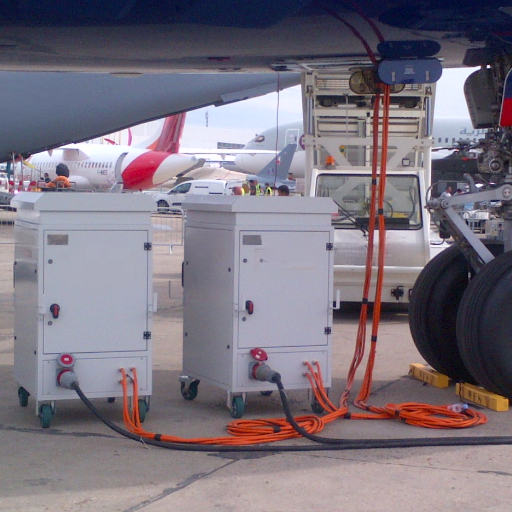
Ground support equipment, or GSE, covers every vehicle, unit, and system that services an aircraft while it is on the ground. Think of it as the life-support system for a parked plane. Without GSE, an aircraft cannot load baggage, receive passengers, get pushed back from the gate, or even keep its cabin cool on a hot tarmac.
GSE falls into two broad categories: powered and non-powered. Non-powered GSE includes baggage carts, dollies, and ladders. Powered GSE includes the systems that demand real electrical or fuel energy: ground power units, pre-conditioned air carts, cargo loaders, pushback tugs, belt loaders, and catering trucks. It is this powered category that drives your ground support equipment power supply decisions.
The transition from conventional diesel-powered GSE to electric GSE, or eGSE, is reshaping airport operations worldwide. The reasons are straightforward. Diesel GSE produces local emissions, noise levels hitting 85-95 dB, and increasingly runs afoul of airport environmental mandates. Electric alternatives eliminate direct emissions at the point of use, cut noise to levels below 65 dB, and reduce the complexity of maintaining combustion engines in a 24-hour operational environment.
Want to see how much power your apron actually needs? Contact our airport engineering team for a free apron power assessment based on your GSE fleet and gate layout.
The Shift to Electric GSE
Regulatory Drivers
Airports are under pressure to clean up ground operations. Heathrow, Changi, and Los Angeles International have all published targets for net-zero ground operations by 2030-2035. Local air quality regulations in the European Union and several U.S. states now penalize or outright ban diesel GSE in certain zones. The consequence is simple: airports that don’t electrify their GSE fleets face operational restrictions, fines, or loss of airline contracts from carriers with their own sustainability commitments.
Industry Adoption Trends
The eGSE market is growing at 6-8 percent CAGR, driven by airline mandates at major hubs and ground handling company fleet transitions. Major carriers now specify electric GSE availability in their ground handling contracts. Ground handling companies are responding by phasing out diesel tugs, loaders, and PCA units on multi-year replacement cycles.
The electrification trend creates a systems problem. Each electric GSE unit needs power, and that power has to come from somewhere. Battery-electric GSE needs charging infrastructure. Continuous-load electric GSE, like electric PCA units and some cargo systems, needs dedicated circuit capacity. If your electrical plan only accounts for the aircraft GPU, you’ll find yourself plugging a lot of extension cords into an already overloaded system.
Power Requirements by GSE Category
Sizing a ground support equipment power supply starts with knowing what each piece of equipment actually draws. Here are the numbers airport engineers use for apron power budgeting.
Aircraft GPUs
Aircraft ground power units are already the best-understood piece of the puzzle. A narrow-body jet like a Boeing 737 or Airbus A320 typically needs 90 kVA. Wide-body aircraft like the A330, A350, or B777 draw 140-180 kVA. We’ve covered aircraft ground power frequency converter sizing and GPU frequency converter selection in detail in earlier guides.
Pre-Conditioned Air (PCA)
Pre-conditioned air units keep the cabin cool or warm while the aircraft’s auxiliary power unit is shut down. Electric PCA units draw 30-60 kVA depending on aircraft size and ambient temperature. Hot-climate airports in the Middle East or Southeast Asia should plan for the upper end of that range. Unlike battery-powered GSE, electric PCA is typically a continuous load for the duration of the turn.
Cargo Handling Equipment
Electric cargo loaders run 20-30 kVA continuous, with peak draws reaching 40-50 kVA during lift and translation. Electric belt loaders are smaller, typically 10-15 kVA. The key consideration here is duty cycle. A cargo loader may only operate for 20-30 minutes per turn, but when it runs, it pulls hard.
Pushback and Towing
Electric pushback tugs draw 15-25 kVA during operation, with high inrush current during motor startup. Electric tow tractors range 10-20 kVA. These loads are intermittent but cannot be overlooked, especially during tight turnarounds when multiple pushbacks may occur simultaneously across adjacent gates.
Catering and Cleaning Trucks
Electric catering trucks typically need 15-25 kVA. Cleaning equipment adds smaller loads, usually under 10 kVA per unit, but multiple units may operate simultaneously during a deep clean or overnight turnaround.
GSE Power Requirements Summary
| GSE Category | Typical Power Draw | Peak / Notes |
|---|---|---|
| Aircraft GPU (narrow-body) | 90 kVA | Up to 180 kVA for wide-body |
| Pre-conditioned air (PCA) | 30-60 kVA | Continuous load; climate-dependent |
| Electric cargo loader | 20-30 kVA | 40-50 kVA peak during lift |
| Electric belt loader | 10-15 kVA | Intermittent duty |
| Electric pushback tug | 15-25 kVA | High inrush at startup |
| Electric tow tractor | 10-20 kVA | Intermittent duty |
| Electric catering truck | 15-25 kVA | Intermittent duty |
This table alone addresses a major content gap in competing articles. Most competitor pages list GSE types but never consolidate the actual power numbers in one place. Use this data as the foundation for your apron power budget.
Static Converter Sizing for Multi-Equipment Aprons
Calculating Total Apron Load
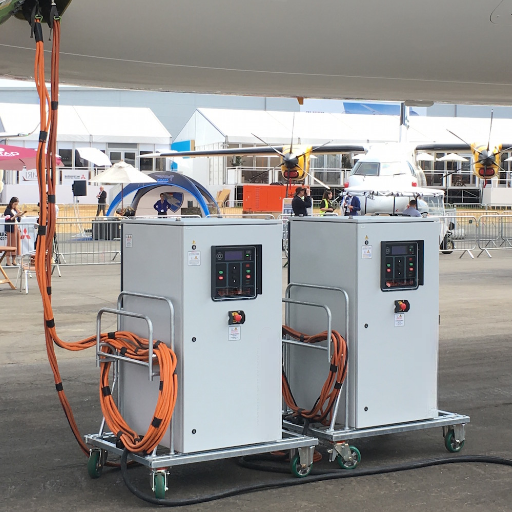
Here’s where integrated planning matters. A single gate doesn’t just need a GPU. During a peak turnaround, you might have the GPU connected, the PCA running, a cargo loader lifting containers, and a catering truck at the forward galley door. If you size your static frequency converter or distribution system for GPU alone, you’ll overload your supply.
The solution is a diversity factor. Not every piece of GSE runs at full load simultaneously. Airport electrical engineers typically apply a diversity factor of 0.7 to 0.85 for GSE loads, depending on operational patterns. A busy hub with tight turnarounds needs a lower diversity factor than a regional airport with staggered schedules.
Worked Example: 4-Gate Apron Power Budget
Let’s size a ground support equipment power supply for a 4-gate regional apron serving narrow-body aircraft.
| Gate / Load | Unit Power | Quantity | Subtotal |
|---|---|---|---|
| GPU (narrow-body) | 90 kVA | 4 | 360 kVA |
| PCA | 45 kVA | 4 | 180 kVA |
| Cargo loader | 25 kVA | 2 | 50 kVA |
| Belt loader | 12 kVA | 2 | 24 kVA |
| Pushback tug | 20 kVA | 2 | 40 kVA |
| Catering truck | 20 kVA | 2 | 40 kVA |
| eGSE charging | 30 kVA | 2 | 60 kVA |
| Raw total | 754 kVA | ||
| With 0.75 diversity | 565 kVA |
A 600 kVA static converter or distributed converter bank would cover this apron comfortably with headroom for growth. If Linda Hartman’s team had run this calculation before their GPU-only upgrade, they would have spotted the shortfall immediately.
Converter Selection for Multi-Equipment Service
You have two architectural choices. A single large centralized converter feeds multiple gates through a distribution network. Multiple smaller point-of-use converters sit at each gate or small gate group. Centralized systems offer easier maintenance and lower per-kVA cost. Point-of-use systems reduce cabling costs and provide redundancy. For mixed GSE loads that include both 400Hz aircraft power and 50/60Hz GSE power, you may need a hybrid architecture or separate distribution systems. Our airport 400Hz power supply design guide covers infrastructure architecture in more detail.
Planning a multi-gate apron upgrade? Talk to our engineers about integrated converter sizing for your full GSE fleet, not just your aircraft GPU.
Power Quality Requirements for Sensitive GSE
Aircraft power quality gets all the attention. GSE power quality deserves just as much scrutiny.
Electric cargo loaders use variable frequency drives, or VFDs, to control lift and drive motors. Those VFDs are sensitive to voltage sags and harmonic distortion. If your ground support equipment power supply introduces harmonics from other loads, you can trip a cargo loader mid-lift. That’s a safety issue, not just an inconvenience.
Battery chargers for electric pushback tugs and tow tractors introduce their own harmonic signature. Large battery charger banks can create significant 5th and 7th harmonic currents that travel back through your distribution system. If those harmonics reach your 400Hz aircraft supply, they can affect the clean power your 400Hz frequency converter is supposed to deliver.
The practical fix is harmonic filtering at the converter or distribution level. Static frequency converters with active front ends and output filters can supply both aircraft and GSE loads while keeping total harmonic distortion within acceptable limits. When you’re specifying a converter for multi-use apron service, ask for harmonic data under mixed-load conditions, not just the aircraft power spec sheet.
Airport Electrical Infrastructure Upgrades
Distribution Capacity Assessment
Before you buy a single electric tug, audit your existing apron electrical capacity. Many airports built their gate distribution systems in the 1990s or early 2000s, when a GPU and some lighting were the only loads. A full eGSE transition can triple or quadruple the power demand at each gate.
Start with the upstream transformer and switchgear. Can your substation handle an additional 400-600 kVA per gate group? If not, you’ll need a transformer upgrade before you can deploy the GSE. This is typically the longest-lead item in an eGSE transition, so identify it early.
Charging Station Integration
Battery-electric GSE needs charging infrastructure, and that infrastructure needs its own power budget. DC fast chargers for pushback tugs can draw 30-50 kVA each. If you have four tugs on a charger bank, that’s 120-200 kVA of additional load that has nothing to do with aircraft power.
The integration challenge is coordination. Your 400Hz GPU circuits and your eGSE charging circuits may share the same transformer or switchboard. Size for the combined peak, or install load management systems that throttle chargers when aircraft GPU demand is high.
Cable and Switchgear Upgrades
Cable sizing for combined GSE plus GPU loads follows standard voltage-drop calculations, but with one twist: the duty cycles differ. Aircraft GPU is continuous for 30-90 minutes. Cargo loader peaks are brief but intense. PCA runs continuously. Your cable and breaker sizing must handle the thermal profile of the combined load, not just the arithmetic sum.
ROI of Electric GSE with Static Power Supply
Capital Cost Comparison
Electric GSE carries a higher upfront price tag than diesel equivalents. An electric pushback tug can cost 30-50 percent more than a diesel tug. Electric cargo loaders and PCA units carry similar premiums. Infrastructure upgrades add another layer of capital expense: transformers, switchgear, cable runs, and charging stations.
Operating Savings
The operating savings are where the business case flips. Electric GSE eliminates diesel fuel purchases, which typically run 15,000−15,000−30,000 per gate annually depending on utilization and local fuel prices. Maintenance costs drop 40-60 percent because electric drivetrains have fewer moving parts, no oil changes, and no exhaust after-treatment systems.
Worked Example: 4-Gate Apron 10-Year TCO
| Cost Category | Diesel GSE Fleet | Electric GSE + Static Power |
|---|---|---|
| Initial GSE purchase | $800,000 | $1,100,000 |
| Static converter/infrastructure | $50,000 (basic) | $320,000 (integrated) |
| Annual fuel/energy | $72,000 | $28,000 |
| Annual maintenance | $48,000 | $22,000 |
| 10-year operating total | $1,200,000 | $820,000 |
| 10-year TCO | $2,050,000 | $1,920,000 |
The electric vehicle fleet breaks even around the fifth year and saves approximately $130,000 over the next four years. Extending this figure to a 20-gate hub, the savings over ten years would be $130,000 for a four-gate helipad. Expanding this further to a 20-gate hub, the savings over ten years would reach $650,000, in addition to advantages in regulatory compliance and noise reduction that cannot be reflected in a simple Total Cost of Ownership (TCO) table.
Near a residential neighborhood, the noise benefit alone can justify the investment. A regional airport in Northern Europe eliminated overnight noise complaints entirely after switching from diesel to electric GSE powered by static converters. Residents who once called the noise hotline three times a week stopped calling altogether. The airport’s community relations budget shrank, and its overnight slot approvals improved.
Frequently Asked Questions
What is the total power needed for a fully electrified gate?
A fully electrified narrow-body gate typically needs 150-200 kVA. A wide-body gate needs 250-350 kVA. These totals include GPU, PCA, cargo equipment, and charging infrastructure.
Can the existing 400Hz infrastructure support electric GSE?
Not directly. Most electric GSE operate at 50Hz or 60Hz, not 400Hz. You’ll need a separate distribution or a multi-output static converter system that can supply both frequencies. However, the same input infrastructure can feed both systems if sized for the combined load.
How long does it take to charge an electric GSE between flights?
Charging times vary by equipment. Pushback tugs using DC fast charging can reach 80 percent capacity in 30-45 minutes. Belt loaders and tow tractors with smaller batteries may charge fully during a typical turnaround. The key is sizing your charger count to match your fleet size and utilization pattern.
What is the payback period for transitioning to electric GSE?
Most airport eGSE transitions reach payback in 4-6 years, depending on fuel prices, utilization rates, and local electricity costs. High-utilization gates at busy hubs pay back faster because the fuel and maintenance savings accumulate more quickly.
Do all airports need to upgrade their electrical distribution?
Most do. Airports built before the eGSE era rarely sized gate distribution for multi-equipment electrified loads. A capacity audit should be your first step before committing to any eGSE procurement.
What happens during a power outage with all-electric GSE?
Critical GSE functions should have backup power or a battery reserve. Most electric GSEs have enough battery capacity to complete an active turnaround even if shore power drops. For extended outages, airports typically maintain a small fleet of backup diesel units or mobile generators for essential operations.
Can static converters power both aircraft and GSE simultaneously?
Yes, if specified for mixed-load operation. Multi-output static converters or converter banks with proper distribution can supply 400Hz aircraft power and 50/60Hz GSE power from the same input. The key is sizing for the diversified total load and managing harmonics.
What are the noise benefits of electric GSE?
Diesel GSE operates at 85-95 dB. Electric GSE and static converters run below 65 dB. The difference is dramatic enough to eliminate noise complaints at airports near residential areas and allow 24-hour operations without community pushback.
Conclusion
Full GSE electrification requires integrated power planning. Sizing your ground support equipment power supply for the aircraft GPU alone will leave you 40 percent short on capacity when the electric cargo loaders, PCA units, and charging stations come online. The airports that get this right run the numbers for the full apron ecosystem upfront, apply realistic diversity factors, and size their static converters and electrical infrastructure for the combined load.
The business case is there. The regulatory pressure is real. The technology is proven. What separates the smooth transitions from the costly delays is whether the power plan covers every piece of equipment on the apron, not just the aircraft connection.
Ready to design your integrated GSE power system? Contact Shandong Electric for a customized apron power assessment and static converter specification built around your full electric GSE fleet.
